CROWN / Mathematics

Nenad Bach and Darko Žubrinić

Number Theory

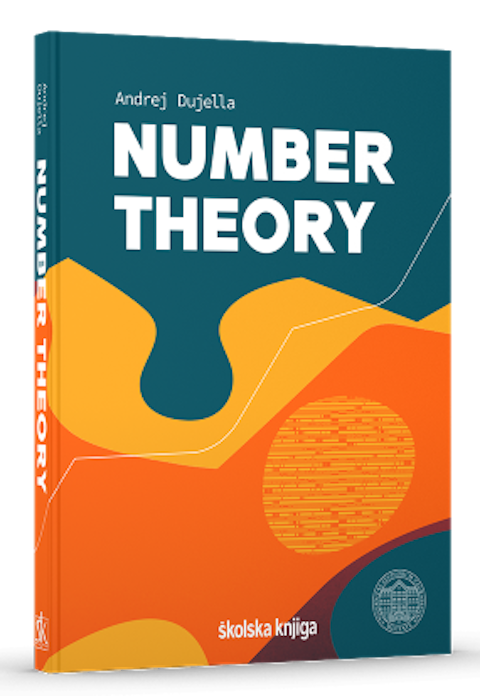
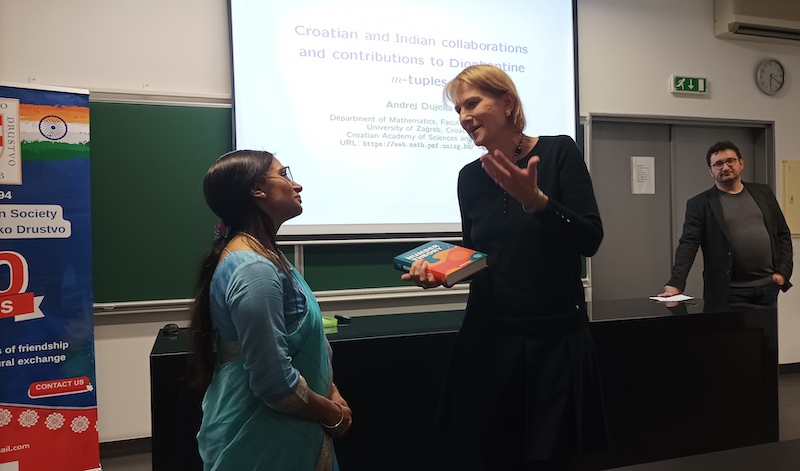
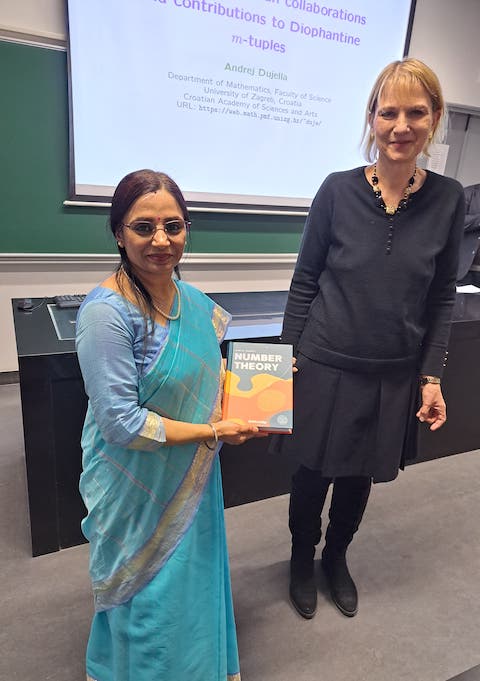
Andrej Dujella's monograph Number Theory translated from Croatian

By Nenad N. Bach and Darko Žubrinić
Published  04/19/2021

Monograph by distinguished Croatian expert in Number Theory published in Zagreb in 2021


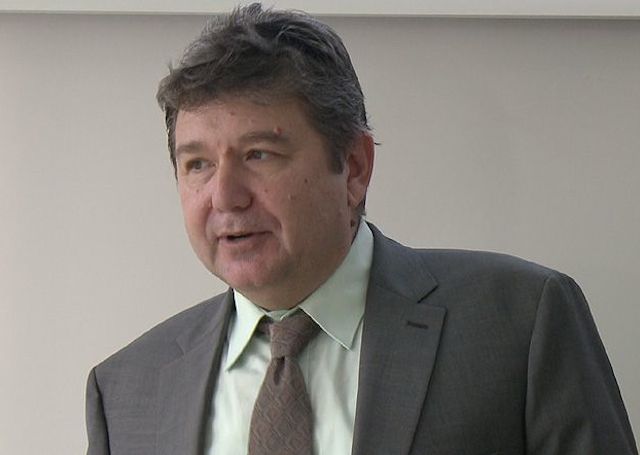
Andrej Dujella, distinguished Croatian mathematician, expert in Number Theory,
a member of Croatian Academy of Sciences and Arts
Textbook of the University of Zagreb
Publisher: Školska knjiga, Zagreb, 2021.
Translated by Petra Švob
ISBN: 978-953-0-30897-8
621 pages, 17 × 24 cm

The book can be purchased at
Amazon.co.uk, Amazon.de, Amazon.com, Amazon.ca, Amazon.es, Amazon.fr, Amazon.it and Školska knjiga.


Description of the monograph by Andrej Dujella

Number theory is a branch of mathematics that is primarily focused on the study of positive integers, or natural numbers, and their properties such as divisibility, prime factorization, or solvability of equations in integers. Number theory has a very long and diverse history, and some of the greatest mathematicians of all time, such as Euclid, Euler and Gauss, have made significant contributions to it. Throughout its long history, number theory has often been considered as the "purest" branch of mathematics in the sense that it was the furthest from any concrete application. However, a significant change took place in the mid-1970s, and nowadays, number theory is one of the most important branches of mathematics for applications in cryptography and secure information exchange.

This book is based on teaching materials from the courses Number Theory and Elementary Number Theory, which are taught at the undergraduate level studies at the Department of Mathematics, Faculty of Science, University of Zagreb, and the courses Diophantine Equations and Diophantine Approximations and Applications, which were taught at the doctoral program of mathematics at that faculty. The book thoroughly covers the content of these courses, but it also contains other related topics such as elliptic curves, which are the subject of the last two chapters in the book. The book also provides an insight into subjects that were and are at the centre of research interest of the author of the book and other members of the Croatian group in number theory, gathered around the Seminar on Number Theory and Algebra.

This book is primarily intended for students of mathematics and related faculties who attend courses in number theory and its applications. However, it can also be useful to advanced high school students who are preparing for mathematics competitions in which at all levels, from the school level to international competitions, number theory has a significant role, and for doctoral students and scientists in the fields of number theory, algebra and cryptography.

Contents

Preface to the Croatian edition

Preface to the English edition

1. Introduction
1.1. Peano's axioms
1.2. Principle of mathematical induction
1.3. Fibonacci numbers
1.4. Exercises

2. Divisibility
2.1. Greatest common divisor
2.2. Euclid's algorithm
2.3. Primes
2.4. Exercises

3. Congruences
3.1. Definition and properties of congruences
3.2. Tests of divisibility
3.3. Linear congruences
3.4. Chinese remainder theorem
3.5. Reduced residue system
3.6. Congruences with a prime modulus
3.7. Primitive roots and indices
3.8. Representations of rational numbers by decimals
3.9. Pseudoprimes
3.10. Exercises

4. Quadratic residues
4.1. Legendre's symbol
4.2. Law of quadratic reciprocity
4.3. Computing square roots modulo p
4.4. Jacobi's symbol
4.5. Divisibility of Fibonacci numbers
4.6. Exercises

5. Quadratic forms
5.1. Sums of two squares
5.2. Positive definite binary quadratic forms
5.3. Sums of four squares
5.4. Sums of three squares
5.5. Exercises

6. Arithmetical functions
6.1. Greatest integer function
6.2. Multiplicative functions
6.3. Asymptotic estimates for arithmetic functions
6.4. Dirichlet product
6.5. Exercises

7. Distribution of primes
7.1. Elementary estimates for the function π(x)
7.2. Chebyshev functions
7.3. The Riemann zeta-function
7.4. Dirichlet characters
7.5. Primes in arithmetic progressions
7.6. Exercises

8. Diophantine approximation
8.1. Dirichlet's theorem
8.2. Farey sequences
8.3. Continued fractions
8.4. Continued fraction and approximations to irrational numbers
8.5. Equivalent numbers
8.6. Periodic continued fractions
8.7. Newton's approximants
8.8. Simultaneous approximations
8.9. LLL algorithm
8.10. Exercises

9. Applications of diophantine approximation to cryptography
9.1. A very short introduction to cryptography
9.2. RSA cryptosystem
9.3. Wiener's attack on RSA
9.4. Attacks on RSA using the LLL algorithm
9.5. Coppersmith's theorem
9.6. Exercises

10. Diophantine equations I
10.1. Linear Diophantine equations
10.2. Pythagorean triangles
10.3. Pell's equation
10.4. Continued fractions and Pell's equation
10.5. Pellian equation
10.6. Squares in the Fibonacci sequence
10.7. Ternary quadratic forms
10.8. Local-global principle
10.9. Exercises

11. Polynomials
11.1. Divisibility of polynomials
11.2. Polynomial roots
11.3. Irreducibility of polynomials
11.4. Polynomial decomposition
11.5. Symmetric polynomials
11.6. Exercises

12. Algebraic numbers
12.1. Quadratic fields
12.2. Algebraic number fields
12.3. Algebraic integers
12.4. Ideals
12.5. Units and ideal classes
12.6. Exercises

13. Approximation of algebraic numbers
13.1. Liouville's theorem
13.2. Roth's theorem
13.3. The hypergeometric method
13.4. Approximation by quadratic irrationals
13.5. Polynomial root separation
13.6. Exercises

14. Diophantine equations II
14.1. Thue equations
14.2. Tzanakis' method
14.3. Linear forms in logarithms
14.4. Baker-Davenport reduction
14.5. LLL reduction
14.6. Diophantine m-tuples
14.7. Exercises

15. Elliptic curves
15.1. Introduction to elliptic curves
15.2. Equations of elliptic curves
15.3. Torsion group
15.4. Canonical height and Mordell-Weil theorem
15.5. Rank of elliptic curves
15.6. Finite fields
15.7. Elliptic curves over finite fields
15.8. Applications of elliptic curves in cryptography
15.9. Primality proving using elliptic curves
15.10. Elliptic curve factorization method
15.11. Exercises

16. Diophantine problems and elliptic curves
16.1. Congruent numbers
16.2. Mordell's equation
16.3. Applications of factorization in quadratic field
16.4. Transformation of elliptic curves to Thue equations
16.5. Algorithm for solving Thue equations
16.6. abc conjecture
16.7. Diophantine m-tuples and elliptic curves
16.8. Exercises

References

Notation Index

Subject Index


Finnish mathematician Pentti Haukkanen wrote a review about the book for Zentralblatt MATH, available at
https://zbmath.org/?q=an%3A07333933
Here, we cite his opinion about it:

This book is a beautiful invitation to number theory. It provides interesting connections between various fields of number theory. Proofs are presented in a concise form. I think that this is a useful opus for a wide branch of readership interested in number theory.


Presentation of Dujella's book Number Theory published in EMS Magazine (edition of European Mathematical Society), written by professor Jean-Paul Allouche (IMJ-PRG, Sorbonne, Paris):

https://euromathsoc.org/magazine/issues/121/mag-43

An excerpt from the presentation:

A very recent book, entitled Number Theory and based on teaching materials, has been written by A. Dujella. Devoted to several subfields of this domain, this book is both extremely nice to read and to work from.
...

this book addresses many jewels of number theory. This is done in a particularly appealing way, mostly elementary when possible, with many well-chosen examples and attractive exercises. I arbitrarily choose two delightful examples, the kind of "elementary" statements that a beginner could attack, but whose proofs require some ingenuity, namely the unexpected statements 4.6 and 4.7.
...

The book also comprises short historical indications and 426 references. It really made me think of my first reading of Hardy and Wright, and I almost felt regret that I cannot start studying Number Theory again from scratch, but using this book! I highly recommend it not only to neophytes, but also to more "established" scientists who would like to start learning Number Theory, or to refresh and increase their knowledge of the field in an entertaining and subtle way.


Mathematical Association of America
Review of Andrej Dujella's monograph "Number Theory" written by Caleb McWorther

... The book presents an appropriately challenging, focused read that covers a large swath of topics. This makes the book very useful for a more advanced undergraduate number theory course, a department having several undergraduate number theory offerings, or a two-sequence course in number theory. The level of simultaneous breadth and depth offered in this book simply cannot be found in other standard texts like Burton's Elementary Number Theory, Barnett's Elements of Number Theory, or Adler and Coury's The Theory of Numbers. For a similar treatment of the expansiveness of number theory, one would have to turn to Ireland and Rosen's A Classical Introduction to Modern Number Theory, which would not be appropriate for many undergraduate audiences. This book could also be perfectly used in a single semester graduate course in number theory wishing to give students a "birds eye view" of number theory to direct their interests. Wonderfully for both audiences, the book contains plenty of recent results to capture the reader's attention and give a flavor for modern research. Although not overly abundant, the exercises are not guilty of superfluous repetition and are instead focused on pushing the essentials for each topic. Many chapters address open problems that an instructor could assign students to examine. Above all, Number Theory does a masterful job at capturing the subtle and graceful intertwining of the analytic, the algebraic, and the combinatorial with more traditional elementary number theory.


The Mathematical Intelligencer

This extremely important book first appeared in a Croatian edition in 2019 and has now been translated into English (along with a few minor corrections and updates) for this edition.

It is particularly well suited for students doing independent research or thesis work, and it is also ideal as a text for specialized graduate courses in number theory. Moreover, anyone seriously interested in number theory will discover in this book a veritable gold mine of information about the current state of affairs in several areas of modern number theory.

While reading this book I also had great fun discovering many things about numbers I had never thought of before.

A detailed information is available here: https://rdcu.be/cU6IT


Michael Penn: From the GOAT number theory book!

One more recommendation by Michael Penn, who in the meantime was in Croatia, attending a math conference organized in the city of Dubrovnik.


A more usual and informal appearance of Professor Andrej Dujella.
This video contains his lively lecture about Number Theoretic problems that he has studied,
originating from Diophantus (Ancient Greek mathematician), Euler and Fermat.


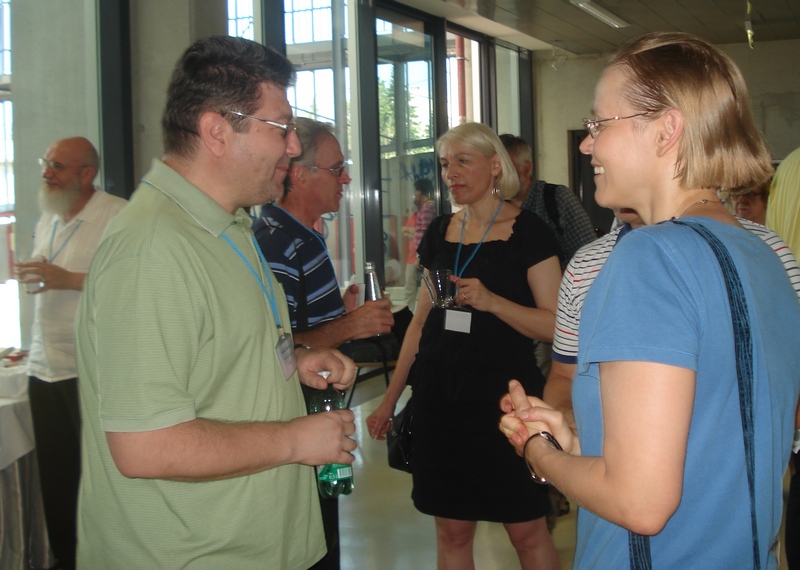
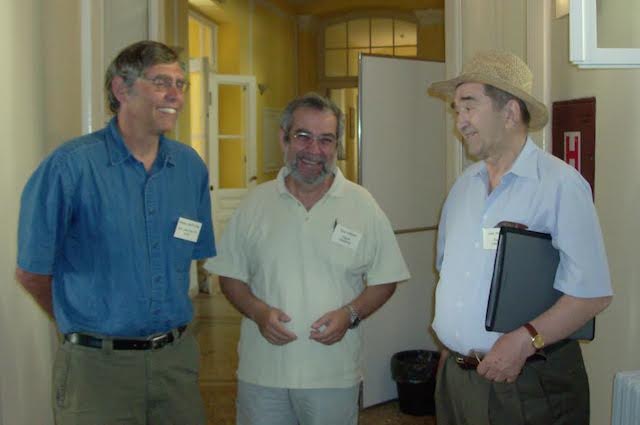
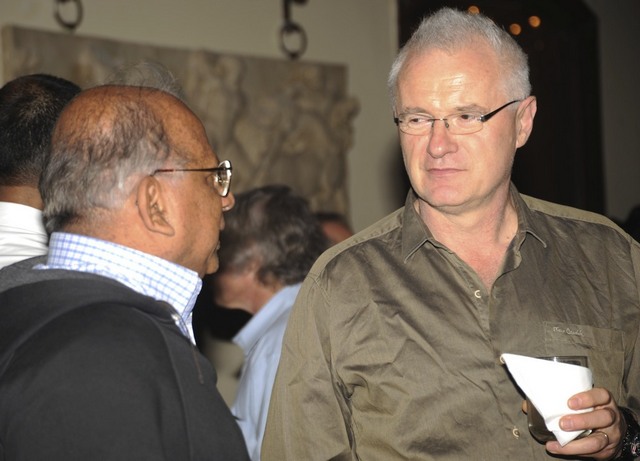
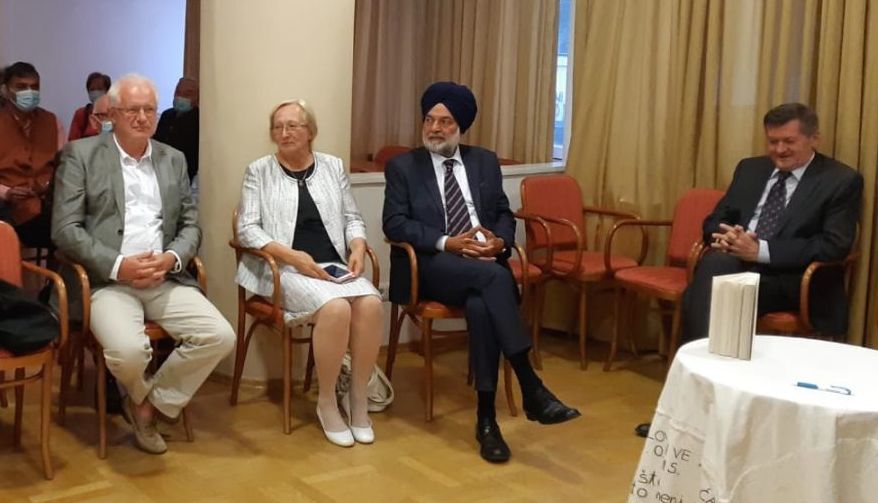
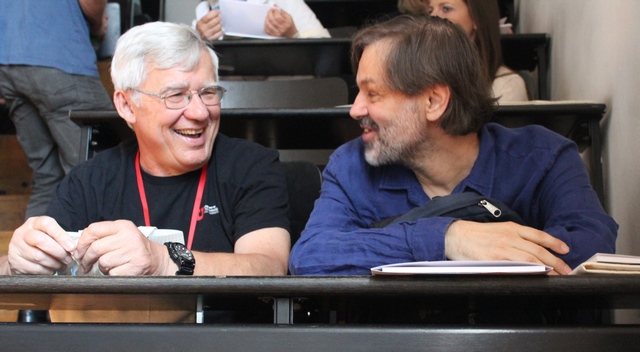
On the left Professor Andrej Dujella, since 2012 a member of Croatian Academy of Sciences and Arts, distinguished expert in Number Theory.
And excellent singer. He is talking to Dr. Vera Tonić, who is working in the field of topology.
On his left Professors Goran Lešaja, Georgia Southern University, USA, and Sonja Štimac, University of Zagreb, one of invited lecturers,
expert in Dynamical Systems. Far on the left, Professor Andrej Ščedrov, expert in Mathematical Logic, Penn State University, USA,
who completed his studies of Mathematics at the University of Zagreb.


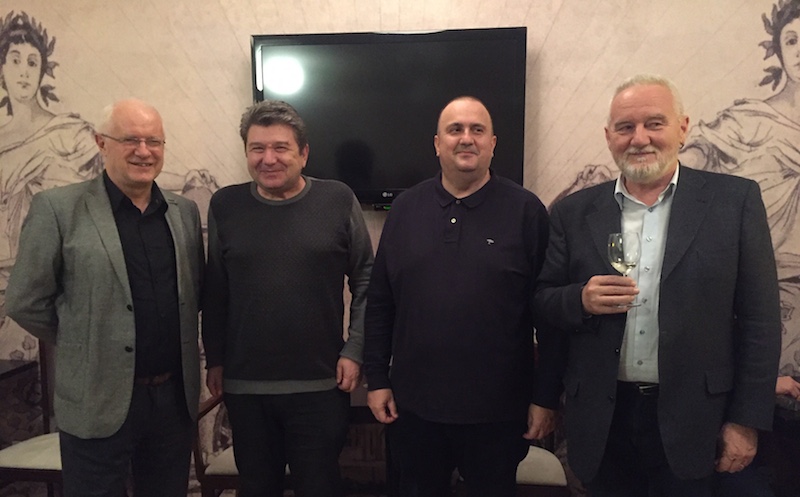
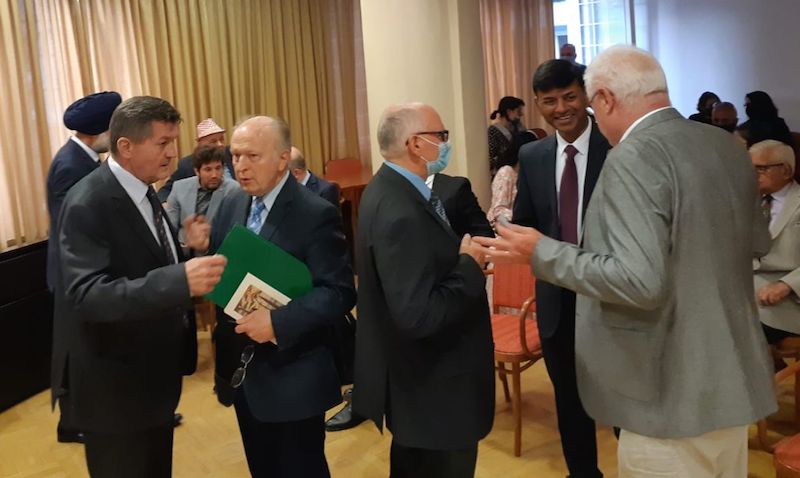
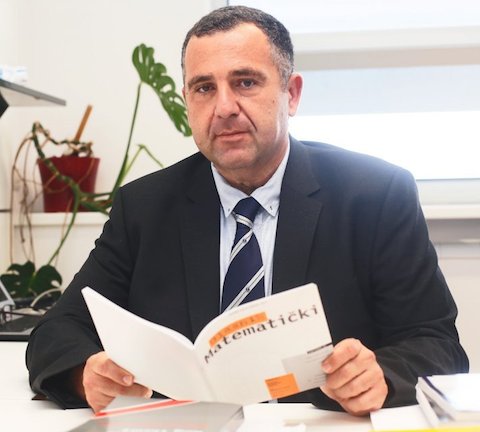
Academicians Marko Tadić and Andrej Dujella (Mathematics Department of the School of Science), Professor Dražen Adamović (editor in chief of Glasnik matematički),
and Professor Tomislav Došlić (Faculty of Civil Enginnering), all of them from the University of Zagreb. Photo taken after a lecture of
Tomislav Šikić about Srinivasa Ramanujan
, the most famous Indian mathematician in history.


Biography of Professor Andrej Dujella, in Croatian.
Interview to Matematičko fizički list: [PDF], in Croatian


A new monograph by Andrej Dujella, to appear soon:
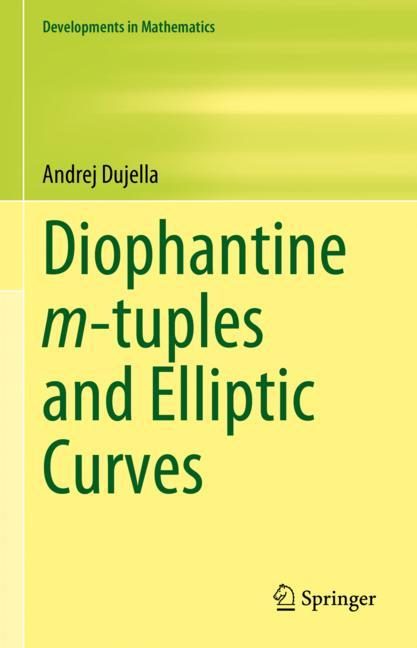
Diophantine m-tuples and Elliptic Curves

Andrej Dujella: Diophantine m-tuples and Elliptic Curves, published by Springer, Cham, 2024.

By Nenad N. Bach and Darko Žubrinić
Published  07/3/2024

Most of my 13 PhD students had theses related to Diophantine m-tuples (and several of their PhD students, too)


cover of the book Diophantine m-tuples and Elliptic Curves
Front matter of the monograph (highly recommended!): [PDF]
Back matter (References and Index): [PDF]

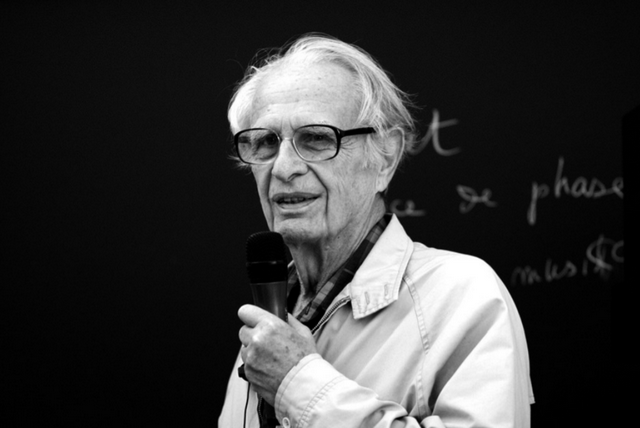
Professor Andrej Dujella, distinguished Croatian mathematician,
is a Fellow of Croatian Academy of Sciences and Arts


The book presents fragments of the history of Diophantine m-tuples, emphasising the connections between Diophantine m-tuples and elliptic curves. It is shown how elliptic curves are used in solving some longstanding problems on Diophantine m-tuples, such as the existence of infinite families of rational Diophantine sextuples.

On the other hand, rational Diophantine m-tuples are used to construct elliptic curves with interesting Mordell-Weil groups, including curves of record rank with agiven torsion group. The book contains concrete algorithms and advice on how to use the software package PARI/GP for solving computational problems.

This book is primarily intended for researchers and graduate students in Diophantine equations and elliptic curves. However, it can be of interest to other mathematicians interested in number theory and arithmetic geometry. The prerequisites are on the level of a standard first course in elementary number theory. Background in elliptic curves, Diophantine equations and Diophantine approximations is provided.

More information


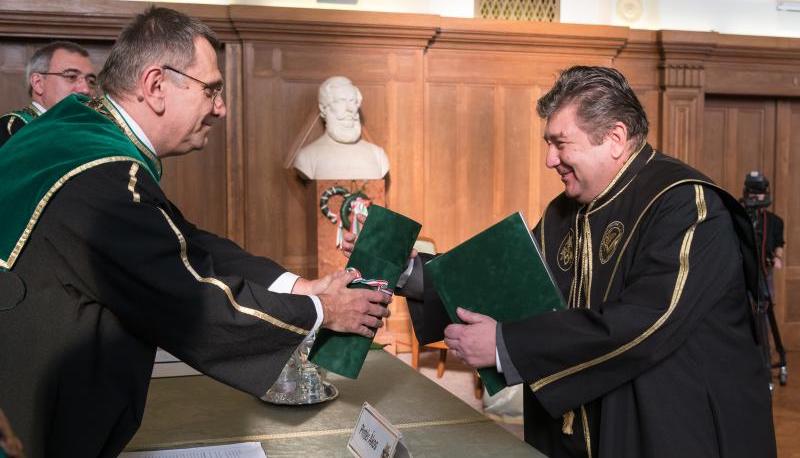
Professor Andrej Dujella is since 2017 a recipient of the honorary doctorate (Doctor Honoris Causa)
from the University of Debrecen, Hungary, due to his very fruitful collaboration with Hungarian
mathematicians. Hungary has a long-standing tradition in Number Theory.


Professor Andrej Dujella is working at the University of Zagreb. He is a member of the Croatian Academy of Sciences. He started to work on diophantine sets as a PhD student. These sets are named after the Greek mathematician Diophantus of Alexandria. Multiplying any two of their elements and adding one gives a square.

The most important result of professor Dujella is that there are only finitely many diophantine quintuples and they are effectively enumerable. Its ingenious proof combines elementary number-theoretic considerations with A. Baker's method, which is one of the most modern tools of diophantine number theory. Professor Dujella generalized the notion of diophantine sets in several directions.

After his efforts this has become very fashionable; many Hungarian, American, Austrian, French and Japanese researchers are working on the topic. He is not only a leading expert of number theory, but has important results on weak parameters of the RSA cryptosystem, which is fundamental for the security of the internet.

Professor Dujella has led a mutually fruitful collaboration with the Faculty of Informatics and with the number theory group of the University of Debrecen (in Hungary) for more than 20 years.

He has published joint papers with seven mathematicians from Debrecen. He led several joint Hungarian-Croatian research projects and was the co-organizer of the Hungarian-Croatian Workshop on Mathematics and Informatics.

Source - University of Debrecen, Hungary


Autobiography of Professor Andrej Dujella, in Croatian

History of Croatian Science


Probability

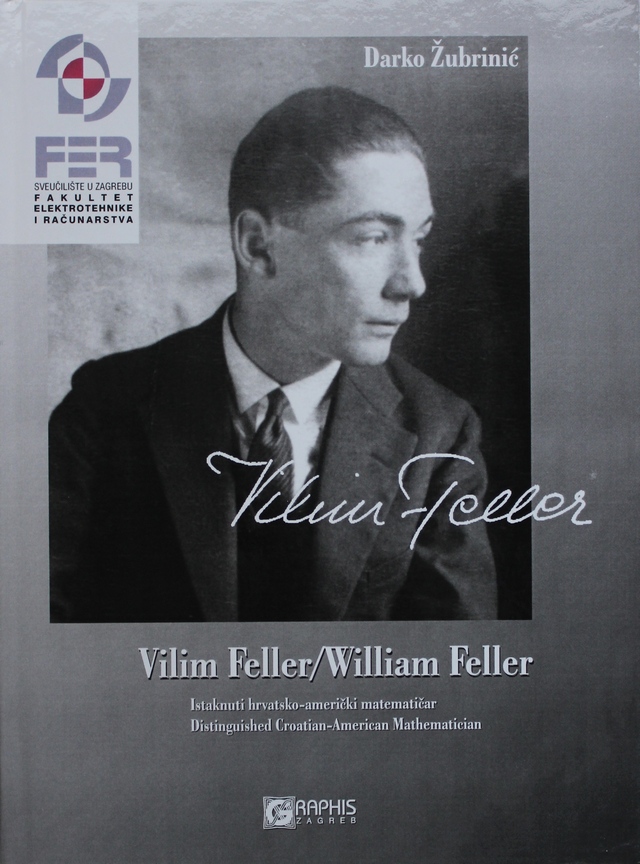
William Feller, a founder of Probability Theory

William Feller (1906-1970), distinguished Croatian-American mathematician, recipient of the National Medal of Science of the USA

Geometry

Stanko Bilinski's rhombic dodecahedron discovered in Croatia in 1960 and nicely described by Matt Parker

Stanko Bilinski's results are cited and discussed by distinguished geometers like Coxeter, Grünbaum and others


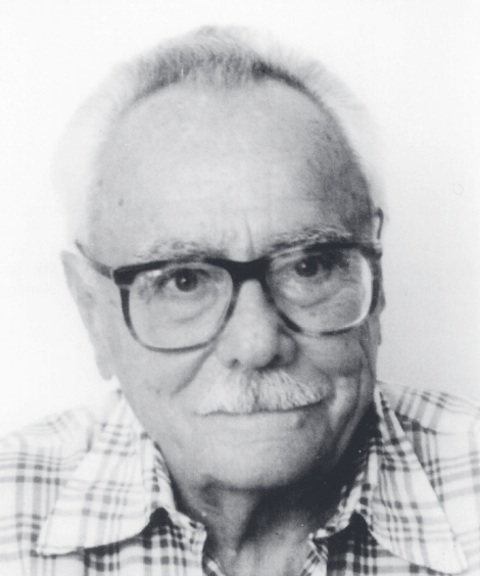
Stanko Bilinski 1909-1998, Croatian mathematician, discoverer of rhombic dodecahedron in 1960,
also called the Bilinski dodecahedron. His short biography in Croatian can be seen here: [PDF].


Academician Stanko Bilinski 1909-1998, was distinguished Croatian mathematician, an expert in in the field of Geometry. In 1960, he discovered the rhombic dodecahedron. A consequence of the the results from his PhD dissertation defended in 1944 (and published in 1948, both at the University of Zagreb) is that there are precisely 14 semiregular (Archemidian) polyhedra. His results are cited and discussed by distinguished geometers like Coxeter, Grünbaum, Miyazaki, Tekada, and others. In 2016, Matt Parker of the University of London (Queen Mary) created a very interesting and entertaining video in Dubrovnik, dealing with this nice geometric object.


The above video by Matt Parker has been created in the city of Dubrovnik in May 2016. Many thanks to Professor Neven Elezović for pointing this out.


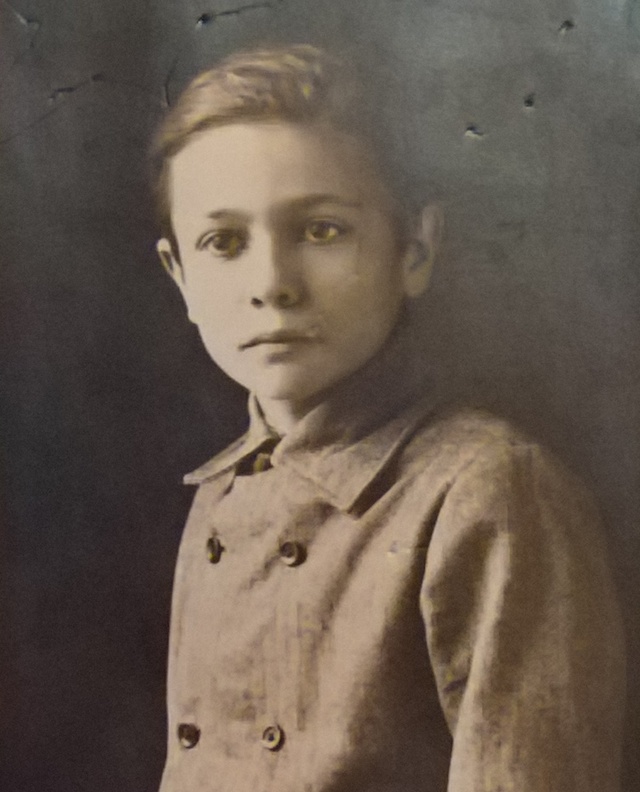
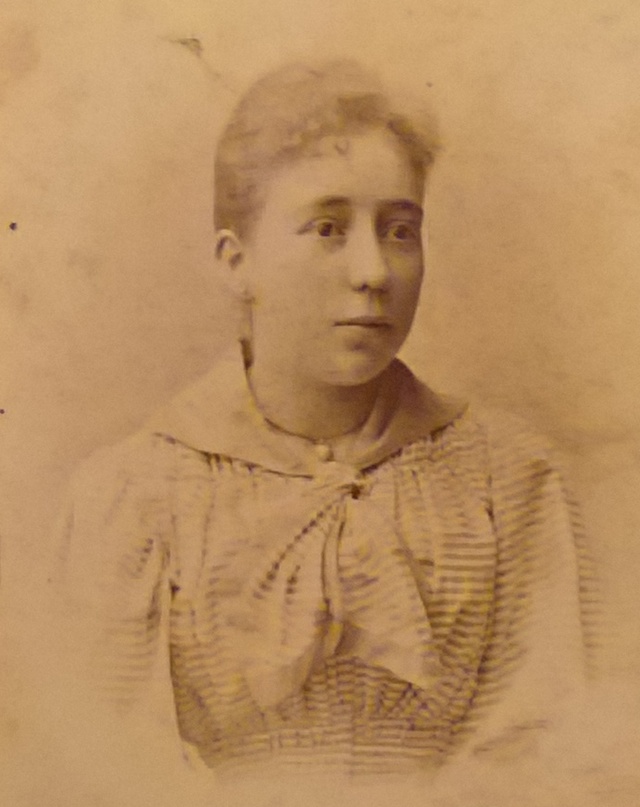
Stanko Bilinski as a child, probably in his native town of Našice on the north of Croatia.
Photo by the courtesy of Jasmina Reis, curator of the Šenoa House in Zagreb.

Paula Ištvanić Bilinski, mother of Stanko Bilinski. She was a (half)sister of Slava Šenoa (b. Ištvanić),
who was married to August Šenoa, distinguished Croatian writer.
Photo by the courtesy of Jasmina Reis, Zagreb.


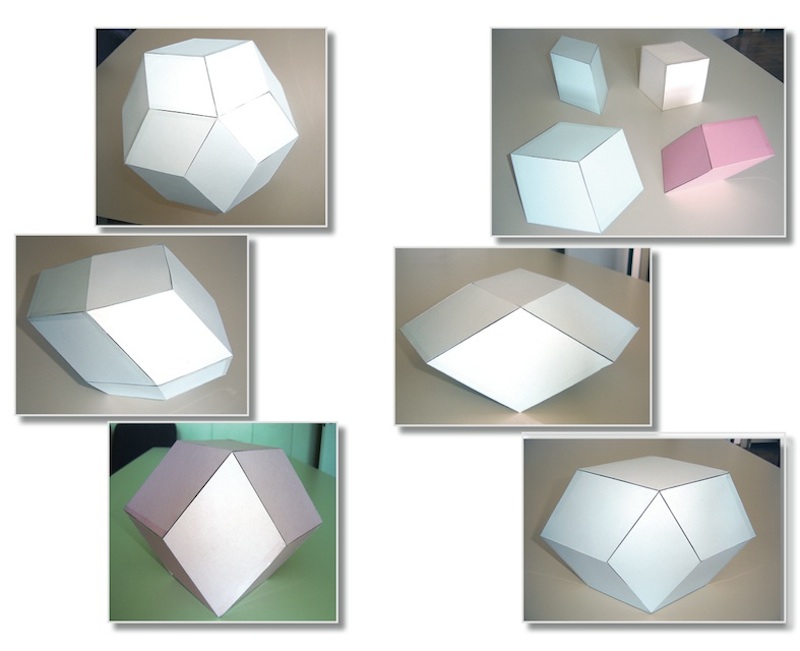
The Bilinski dodecahedron, and assorted parallelohedra, zonohedra,
monohedra, isozonohedra and otherhedra


Branko Grünbaum

Fifty years ago Stanko Bilinski showed that Fedorov's enumeration of convex polyhedra having congruent rhombi as faces is incomplete, although it had been accepted as valid for the previous 75 years. The dodecahedron he discovered will be used here to document errors by several mathematical luminaries. It also prompted an examination of the largely unexplored topic of analogous non - convex polyhedra, which led to unexpected connections and problems.

...

To summarize the situation concerning dodecahedral rhombic mono-hedra, we have the following polyhedra of spherical type:

Two convex dodecahedra (Kepler's and Bilinski's);

Three simply indented dodecahedra (one from Kepler's polyhedron, two from Bilinski's)

One doubly indented dodecahedron (from Bilinski's polyhedron).


The above text is a short excerpt from the following very detailed study:

Grünbaum, Branko (2010), "The Bilinski dodecahedron and assorted parallelohedra, zonohedra, monohedra, isozonohedra, and otherhedra" [PDF], The Mathematical Intelligencer, 32 (4): 5–15,

It is available via the following source: Stanko Bilinski, Wikipedia


Stanko Bilinski: Problem parketiranja [PDF], Matematičko fizički list, LXVII (2016.-2017.)
Many thanks to Dr. Željko Hanjš, editor in chief of this journal, for sending us the article.


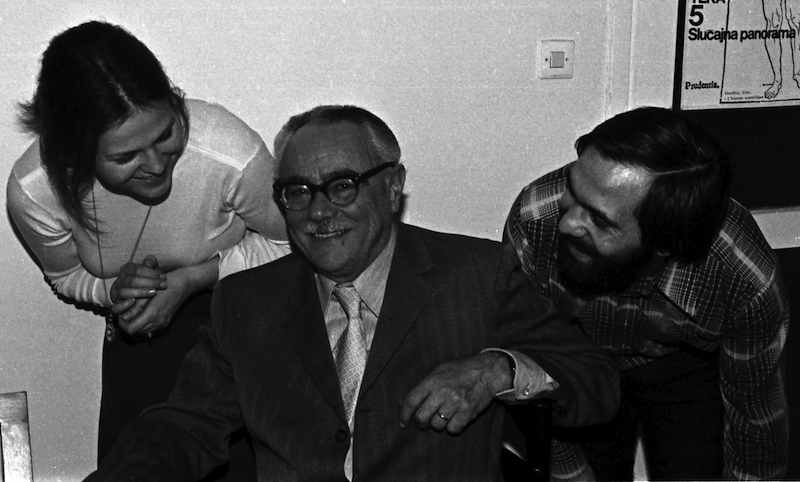
Asia Ivić (then assistant at the Department of Mathematics of the University of Zagreb), Professor Stanko Bilinski
and Mirko Polonijo in June 1975. Photo by the courtesy of Professor Mirko Polonijo. Photo by Miro Kraetzl.

Bilinski dodecahedron which you can rotate with your mouse.


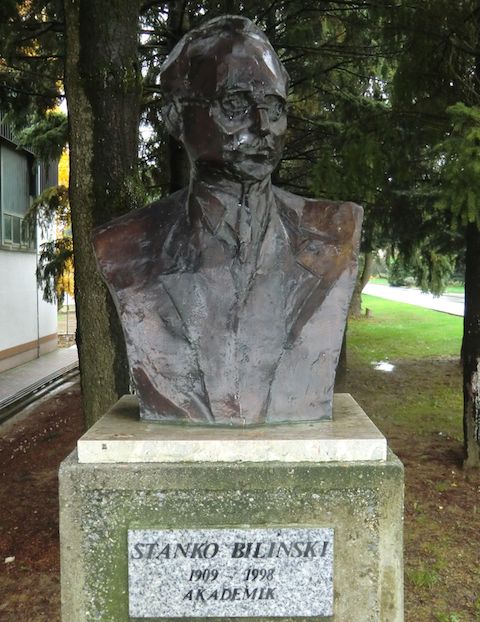
Bust of Stanko Bilinski in front of the Iso Kršnjavi High School in Našice, Bilinski's native town.
Photo by the courtesy of Željko Filjak, director of the school,
where there is the Stanko Bilinski Geometry School founded in 2011.


Akademik Stanko Bilinski (1909. - 1998.)
Životni put i pogledi na matematiku


Mirko Polonijo

U ponedjeljak 6. travnja 1998. godine u Varaždinu je nakon kraće bolesti preminuo akademik Stanko Bilinski, umirovljeni redoviti profesor Matematičkog odjela Prirodoslovno-matematičkog fakulteta Sveučilišta u Zagrebu, značajni i zaslužni hrvatski geometričar koji je svojim dugogodišnjim marljivim i plodonosnim znanstvenim, nastavnim i društvenim radom i djelovanjem ostavio neizbrisiv trag u našoj matematici, višestruko zaduživši našu matematičku znanost, kao i svoje mnogobrojne kolege i učenike. Sprovod je bio dva dana kasnije, u srijedu 8. travnja na zagrebačkom groblju Mirogoj.

Profesor Bilinski, kako smo mu se obraćali svi mi koji smo ga poznavali, rođen je u Našicama 22. travnja 1909. godine, istog datuma i u istom gradu kao Izidor Kršnjavi (1845.), volio je naglasiti.
Majka mu se zvala Paula rođena Ištvanić (bila je sestra Slave Ištvanić, supruge Augusta Šenoe). Otac Stanko rodio se u Beču, a u Našicama je bio šumar kod grofa Pejačevića. Djed s očeve strane, Hipolit, rođen je u Poljskoj, a doselivši u Beč završio je studij farmacije te kasnije u Pregradi otvorio apoteku.

Profesor Bilinski je imao tri sestre: Petru (rođ. 1904.), Maru (rođ. 1905.) i Dragu (rođ. 1911.).
Klasičnu gimnaziju polazio je u Vinkovcima i Zagrebu, a 1932. godine diplomirao je na Filozofskom fakultetu u Zagrebu, grupu za teorijsku matematiku. Zatim je od 1934. do 1940. godine kao gimnazijski profesor poučavao matematiku u Varaždinu (Franjevačka klasična gimnazija), Skoplju i Sušaku. U to se vrijeme, 1937. oženio sa Zlatom rođ. Crnić (1908. - 1992.); imali su dvoje djece: Halku (rođ. 1938.; ima sina Stanislava) i Vandu (rođ. 1944.; ima sinove Miroslava i Ratka).


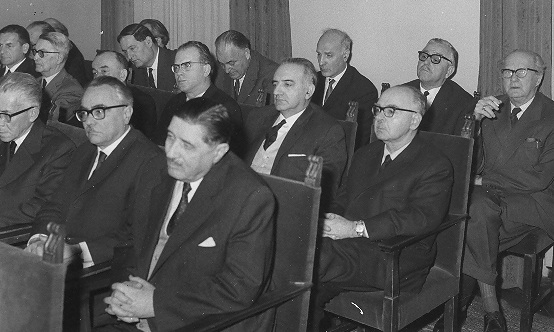
Academician Stanko Bilinski, second from the left. Left to him Professor Vladimir Vranić.
First in the second row (on the right) academician Danilo Blanuša.
Photo by the courtesy of the author of the text.

Vraća se u Zagreb, te od 1940. do 1946. godine radi kao asistent u Geofizičkom zavodu, gdje se bavio meteorologijom, posebice dinamikom grmljavinskih oblaka. Međutim, njegova je prava i istinska ljubav matematika, točnije geometrija, kojoj će posvetiti cijeli svoj život. Stoga istodobno radi na doktorskoj disertaciji s temom o homogenim mrežama u ravnini. Doktorirao je 1944. godine i stekao naslov doktora filozofskih znanosti. Promoviran je 31. srpnja 1944. pred povjerenstvom koje su čŒinili rektor Božidar Špišić, dekan Antun Mayer i promotor Rudolf Cesarec. Bio je to trinaesti doktorat iz područja matematike obranjen na zagrebačkom sveučilištu (prvi je postigao David Segen 1889. godine), ujedno posljednji matematički doktorat postignut na Filozofskom fakultetu.

Od 1946. godine, kada je izdvajanjem matematičko-prirodoslovnog odjela iz Filozofskog fakulteta osnovan Prirodoslovno-matematički fakultet Sveučilišta u Zagrebu, profesor Bilinski radi u Geometrijskom zavodu toga fakulteta. Započeo je kao asistent, zatim je bio docent (1948.), pa izvanredni profesor (1952.) i od 1956. godine je redoviti profesor.

Godine 1949. postaje predstojnikom Geometrijskog zavoda i tu će dužnost obavljati sve do umirovljenja 1978. godine (Zavod za geometriju je svoje djelovanje započeo jošŒ davne 1898. godine kao Katedra za deskriptivnu geometriju na tada osnovanoj Šumarskoj akademiji "prislonjenoj" na Mudroslovni fakultet; prvi je voditelj/predstojnik bio već spomenuti David Segen).

I nakon odlaska u mirovinu profesor je Bilinski dugi niz godina aktivno i vrijedno sudjelovao u radu Zavoda i njegovog znanstvenog seminara, izlažući rezultate svojih istraživanja. Pozorno je pratio, poticao i komentirao rad svojih mlađih kolega, suradnika i učenika. Upravo je u okviru Geometrijskog seminara profesor Bilinski održao svoje posljednje predavanje na našem Sveučilištu, bilo je to 31. svibnja 1993., naslov predavanja "Porodica otupljenih kvaziregularnih poliedara".

Svoje zapaženo matematičko djelovanje profesor Bilinski provodio je i kroz Društvo matematičara i fizičara, jedan je od njegovih utemeljitelja 1949. godine (odnosno 1945. kada je osnovana matematičko-fizička sekcija Hrvatskog prirodoslovnog društva) i vrlo aktivnih članova; pored ostalih dužnosti, bio je i predsjednik Društva od 1959. do 1961. godine.

Profesor Bilinski je kao predstavnik naših matematičara sudjelovao i u radu međunarodnih matematičkih udruga (Internacionalna matematička unija, Unija matematičara Balkana).

Matematičko-fizička sekcija Hrvatskog prirodoslovnog društva počela je 1946. godine s izdavanjem znanstvenog čŒasopisa Glasnik matematičko - fizički i astronomski (koji je izlazio do 1965. godine, kada se dijeli na dva časopisa: "Glasnik matematički" i "Fizika"), čiji je dugogodišnji glavni i odgovorni urednik bio profesor Bilinski (samostalno od 1951. do 1954. godine, zajedno sa Zlatkom Jankovićem od 1955. do 1958. godine, zajedno s Pavlom Papićem od 1959. do 1962. godine). U tom je razdoblju časopis izrastao u uglednu i priznatu matematičku publikaciju, te je razmjenom omogućio pritjecanje velikog broja inozemnih matematičkih časopisa u našu sredinu.

U razdoblju od 1961. do 1974. znanstveni je rad u matematici bio organiziran u okviru Instituta za matematiku Sveučilišta u Zagrebu, na čŒijem je čelu kao direktor profesor Bilinski radio od 1962. do 1968. godine.

Dužnost dekana Prirodoslovno-matematičkog fakulteta obnašao je školske godine 1956./57. Profesor Bilinski je bio dugogodišnji član Jugoslavenske, odnosno Hrvatske akademije znanosti i umjetnosti; član dopisnik u radnom sastavu (ekvivalent današnjem izvanrednom članu) od 1963. godine, a pravi (redoviti) član od 1985. godine. Unutar akademijinog II razreda za matematičke, fizičke, kemijske i tehničke znanosti djelovao je marljivo i zapaženo. Zahvaljujući njegovom trudu mnogi su strani matematičari, posebice geometričari, održali predavanja u Akademiji. Osobito je zaslužan za pokretanje posebnim tematskih svezaka akademijinog Rada; svesci matematičkih znanosti izlaze od 1982. godine. Profesor Bilinski je nad njima stalno bdio potičući naše i strane autore pa nije neobično da u svescima prevladavaju geometrijski sadržaji. Svesci matematičkih znanosti akademijinog Rada izrasli su u značajni međunarodi matematički časopis.

Međunarodnu je priznatost profesor Bilinski doživio i izborom u Austrijsku akademiju znanosti, kao dopisni član od 1980. godine. Za svoj znanstveni rad dobio je profesor Bilinski 1967. godine nagradu Ruđer Bošković, a 1980. državnu (republičku) Nagradu za životno djelo.

Svojim znanstvenim talentom i zalaganjem, širokim znanjem i velikom radnom energijom, kroz dugu profesionalnu karijeru, profesor Bilinski je dao značajan znanstveni doprinos koji u svojoj cjelokupnosti gotovo potpuno pripada geometriji. Napisao je preko pedeset znanstvenih i stručnih radova, a posljedni je znastveni rad objavio 1995. godine kad je već navršio 86 godina.

Geometrija je znanstvena okosnica i konstanta tog plodnog i vrijednog života. Profesor Bilinski je cijenjen u međunarodnim geometrijskim krugovima, spominjan i navođen u mnogim značajnim monografijama. Kako to obično biva, na znanstvenom području, međunarodna priznatost profesora Bilinskog bila je veća od one koju mu je iskazivala domaća sredina. Njegove su preporuke otvarale vrata kod vrhunskih matematičara, na svakom geometrijskom skupu za njega su pitali, iskazujući poštovanje njegovu radu, pozivali su ga i u visokim godinama na međunarodne znanstvene skupove, a on je odlazio i bio s uvažavanjem slušan i pitan.

O svojim znanstvenim rezultatima profesor Bilinski je izlagao na mnogobrojnim međunarodnim skupovima, simpozijima i kongresima (Amsterdam, Edinbourgh, Stockholm, Moskva, Nice, Sofija, Carigrad, Bukurešt, Varna, Weimar, Beč, Graz, Oberwolfach), bio je redoviti sudionik domaćih znanstvenih susreta, te često pozivan na strana i domaća sveučilišta.

Profesor Bilinski je bio vrstan profesor, odličan predavač i pažljivi poučavatelj, znalački pedagog, kojeg je resila očinska blagost i smirenost u obraćanju studentima i kolegama. Studenti su ga cijenili, poštovali i voljeli, mnogi od njih i danas predaju matematiku ili fiziku na našim osnovnim i srednjim školama ili pak sveučilišŒtima. Zahvaljujući njegovim predavanjima mnogih i raznovrsnih geometrijskih kolegija bilo je lako zavoljeti i razumjeti geometriju, a neke je svoje studente privukao da se odluče i za znanstveni rad u tom području. Predavao je i na poslijediplomskom studiju, bio mentor većem broju postdiplomanada, te šestorici doktoranada. Volio je šalu, ugodno društvo, bio je veliki poklonik glazbe i ljubitelj prirode.

Svojim dugim i plodnim znanstvenim, stručnim i nastavničkim radom profesor Bilinski podario je mnogo i mnogima: onima koji su toga svjesni već odavno, onima koji će to tek biti, i onima koji to neće ni znati. Bio je ljubitelj i zaljubljenik geometrije, njezin štovatelj i vrsni znalac, ali također vješt graditelj i uspješni doprinositelj.

Kao predsjednik Društva matematičara i fizičara, 27. 1. 1960. godine na XI. redovitoj godišnjoj skupštini Društva, profesor Bilinski je održao govor pod naslovom "Ekonomsko i kulturno značenje matematike" [S6]. Iduće je godine, 25. 1. 1961. naslov njegovog predsjedničkog govora bio "Utjecaj otkrića neeuklidske geometrije na savremani razvoj nauke" [S7]. Ti zanimljivi i poticajni predsjednički govori jasno iskazuju i otkrivaju poglede, razmišljanja i stavove profesora Bilinskog o matematici i aktualnim kretanjima u njoj, istodobno dozivajući njegov glas svima koji su ga poznavali. Zato ćemo u daljnjem tekstu navesti dijelove spomenutih govora.

Govor "Ekonomsko i kulturno značenje matematike" [S6] započinje slikovitim iznošenjem jednog mišljenja izrečenog u staroj Čitaonici na Marulićevom trgu 19 (tada je voditeljica Čitaonice Društva matematičara i fizičara bila draga i nezaboravna Nada Hofman (1908 - 1997)).

Prije nekog vremena u Čitaonici našŒeg Društva bio se poveo razgovor općenito o matematici. Jedan je naš mlađi kolega tom prilikom izjavio otprilike ovo: "Mi smo matematičari pomalo slični šahistima. Postavljamo neke probleme i rješavamo ih sebi na veselje i zabavu; samo je čudno da nas za to jošŒ i plaćaju." To mišŒljenje daje povod i mogućnost profesoru Bilinskom da opiše svoje gledanje na položaj matematičara s obzirom na prihvaćenost njegova znanstvena djela.


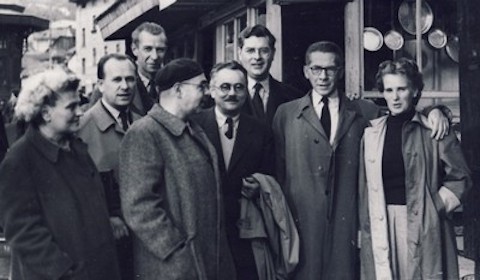
A group of Croatian mathematicians in Sarajevo (Baščaršija): from right to left - Vladimir Vranić with an unknown woman, Zlatko Janković, Stanko Bilinski, Danilo Blanuša, Pavle Papić, probably Ignac Smolec (according to information by Kroacija Kučera) and an unknown woman. Photo by the courtesy of Mladen Vranić of the University of Toronto.

Upusti li se pak neki matematičar u borbu s nekim matematičkim problemom, kojeg je on sam ili neko drugi postavio, sam tok te borbe bit će za publiku posve neinteresantan. Pa i u slučaju da matematičar postavljeni problem svlada i da rezultat svega toga bude objavljen u nekom naučnom članku, taj će rezultat biti neinteresantan za širu publiku, a ponekad i za veliku većinu samih matematičara. U čitanju tog članka uživat će, možda, samo desetak njih, i to onih koji su specijalisti baš u užem području postavljenog problema. Očito je, dakle, da između šaha i matematike postoji razlika.

Zatim će, nakon duhovite primjedbe, profesor Bilinski izložiti još jednu sliku, drugačiji pogled na korisnost i smislenost matematičkog djelovanja. No kad sam već počeo s indiskretnim iznošenjem diskretnih razgovora među matematičarima, neka mi bude dopušteno da još malo tako i nastavim.

Jedan drugi od našŒih mlađih kolega, koji se bavi izvjesnim modernim, a vrlo apstraktnim područjem matematike (nazovimo ga teorija A), uvjeravao je nedavno jednog našeg kolegu fizičara o velikoj vrijednosti pa čak i praktičnom značenju i primjenjivosti teorije A. Za dokaz je iznosio neke rezultate jednog sovjetskog matematičara koji je na osnovi teorije A uspio rješavati probleme jedne druge, klasične matematičke teorije, koja ima mnogostrane praktične primjene u egzaktnim naukama.

Evo, dakle, bitno različitih izjava dvaju naših matematičara o značŒenju, koristi i ulozi matematike. Koja je od njih ispravna? Ili bolje, koja je od njih ispravnija? Odmah će nastaviti iskazujući svoje mišljenja o odnosu znastvenika/matematičara i njegova znanstvena područja. No prije nego pokušamo na to pitanje dati odgovor, osvrnimo se malo na psihološki karakter ovih dviju izjava.

Normalno je da ljudi pridaju znatnu važnost svom vlastitom radu i da visoko cijene objekt svog vlastitog interesa i zanimanja, pa da ga smatraju korisnim, pogotovo onda, ako su ga sami slobodno i po svojoj volji odabrali. Samo onaj se usuđuje govoriti o tom objektu u šali i s prividnim omaložavanjem, kod koga postoji nesumnjiva vjera u vrijednost tog objekta. To je, eto, bio slučaj kod prve od gornjih izjava.

No kod nekih ljudi kadgod ipak ne postoji dovoljno vjere u vrijednost i važnost objekta vlastitog interesa. Takvi neće propustiti priliku, da uvjere druge, a pogotovo same sebe o toj vrijednosti. Čini mi se, eto, da bi to moglo biti u slučaju druge izjave.

Sada profesor Bilinski počinje odgovarati na zadatak postavljen naslovom predavanja. Pređimo sada na samu stvar i pokušajmo uočiti značenje matematike za ljudsku zajednicu i koristi što ih ona pruža, odnosno, što bi ih ona mogla pružiti. No želim pritom istaći, da su gledišta koja će ovdje biti iznesena posve subjektivne prirode i bez pretenzija na nepogrešivost i trajnu valjanost. Značenje matematike, kao uostalom i većine drugih nauka, je dvojako. Tako možemo govoriti o njezinom ekonomskom i njezinom kulturnom značenju.

Prvo od tih značenja odnosi se na pomoć matematike koju ona pruža u svladavanju prirode za dobivanje materijalnih dobara, potrebnih za zadovoljavanje svakodnevnih životnih potreba. Ova pomoć možŒe biti neposredna, kad se direktnom primjenom matematike u tok proizvodnih procesa i u privredi dolazi do povećanja same proizvodnje ili do njenog poboljšanja u bilo kojem pogledu. No ta pomoć može biti i posredna, kada matematika, kao najopćenitija nauka, počinje kao prva stepenica u nizu uzastopnih primjena, pa npr. preko teoretske fizike, fizike, kemije i pojedinih tehničkih nauka djeluje u unapređivanju industrijske proizvodnje. Tu se dakle radi o konkretnoj primjeni matematike pa kad se općenito govori o koristi matematike za ljudsku zajednicu, onda se ponajčešće, a gotovo i isključivo, misli upravo na ovu korist. Ova primjena matematike naglo raste s napretkom civilizacije, a s njom i uloga matematike u povećanju materijalnog blagostanja ljudske zajednice. Već odavna nitko ne sumnja u veliku primjenjivost matematike u egzaktnim i tehničkim naukama, a od početka ovog stoljeća brzo se krči put primjene matematike u mnogim drugim, a naročito u biološkim, medicinskom i ekonomskim naukama.
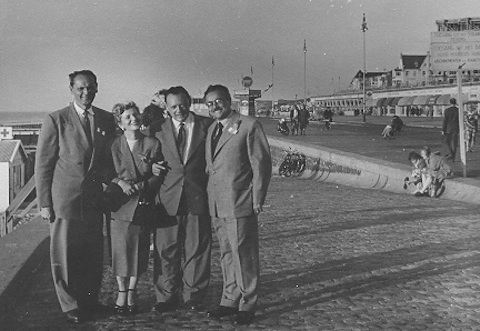

Professor Stanko Bilinski on the right, at the Annual Meeting of the
International Mathematical Union in the Hague. On the left Professor Gjuro Kurepa.
Photo by the courtesy of the author of the text.

U posljednjim decenijama došlo se do spoznaje o velikoj koristi od neposredne primjene matematike u privredi, u proizvodnim procesima i u njihovoj organizaciji. U zemljama na visokom stupnju civilizacije postavljaju se danas matematičari na takve položaje i daju im se takva zaduženja na koja se prije nije ni pomišljalo. Tako npr. u Engleskoj postoje tvornice, u kojima su na rukovodećim položajima ljudi, koji su diplomirani matematičari odnosno doktori matematike. Matematičare postavljaju redovno na takva mjesta, gdje treba rješavati probleme, koji nisu tipični, koji se, dakle, ne rješavaju šablonski, i za njih ne postoje već gotovi recepti, formule i postupci. Tako u velikoj mjeri uposluju matematičare velika industrijska poduzeća, a čak i naučnoistraživački instituti vojske, mornarice i avijacije. Dakako da tu veliku ulogu igraju i moderni računski strojevi.

Međutim, profesor Bilinski naglašava da sve izrečeno nije glavna vrijednost matematike.
Pa ipak, i pored svih mnogostranih koristi, što ih matematika svojim posrednim i neposrednim primjenama pruža čovječanstvu u unapređivanju njegovog materijalnog blagostanja, smatram da njezina glavna vrijednost ne leži u tom - kako smo ga nazvali - ekonomskom značenju. Matematika daje mogućnost da čovjek upoznaje realni odnos stvari u prirodi, pa da tako zadovolji svoju osnovnu kulturnu potrebu za upoznavanjem ovog svijeta u kojem se rodio, do krajnjih granica mogućnosti. Ova žeđ čovjeka da pronikne u suštinu svega što ga okružuje, isto je takva osnovna kulturna potreba, kao i težnja za estetskim doživljajem, tj. kao i potreba umjetnosti. Život u kojem ne bi postojala mogućnost zadovoljavanja ovih osnovnih kulturnih potreba bio bi posve bezvrijedan, pa i pored najvećeg materijalnog blagostanja i mogućnosti potpunog zadovoljavanja svih vegetativnih potreba.

I ovo kulturno značenje matematike očituje se na dva načina. Njezina pomoć može biti posredna. U tom slučaju matematika pomaže drugim naukama: astronomiji, fizici, kemiji, biologiji itd. u njihovom otkrivanju prirodnih zakonitosti. No samo neke matematičke teorije, ili bolje, neki dijelovi nekih matematičkih teorija, podesni su za ovu primjenu. Druge teorije zanimljive su i same po sebi. One nam daju neposredno uvid u realni svijet, otkrivajući raznovrsne kvalitativne i kvantitativne odnose stvari u svijetu. To, što su te teorije često puta i vrlo apstraktne, ne umanjuje njihovu spoznajnu vrijednost, nego nam, naprotiv, s jednog višeg stanovišta pokazuje strukturno-logičku srodnost mnogih realno posve raznorodnih materijalnih sistema stvari u prirodi. Ovako shvaćena, matematika je prirodna nauka. Ona nam otkriva matematičku strukturu svemira; ona je zapravo samo jedan dio kosmologije.

U jednom ranijem članku, "Hoćemo li studirati matematiku?" [S5], namijenjenom srednjoškolcima, profesor Bilinski je gornje misli o značenju matematike kratko sažeo u rečenicu:

"Velike, opsežne i mnogostruke su njezine primjene. No najveće njezino značenje je u njezinoj unutarnjoj kulturnoj vrijednosti, a o ovoj vrijednosti nije lako steći jasniju predodžbu samo na osnovu poznavanja srednjoškolske matematike."

U istom je tekstu usporedio znanstveni rad u matematici i u drugim znanostima. Pritom postoji jedna bitna razlika između naučnog rada u matematici i u ostalim naukama. Dok se u ostalim naukama vrlo često u isti mah gradi i razgrađuje, jer nove teorije nadomještaju one starije, koje se zabacuju pa postaju suvišne, ili se znatno izmjenjuju, dotle se u matematici od samog njenog početka samo gradi. Što je jednom u njoj dokazano kao ispravno, ostaje tako zauvijek. Zato je današnja zgrada matematike golema. Još prije nekih 150 godina bilo je moguće da jedan jedini čovjek upozna sva dotadašnja otkrića u području matematike. No danas i najveći matematičari za cijelog svog života mogu upoznati samo jedan posve maleni njezin dio. Možda je zato i lakše razumjeti činjenicu da se definicije same matematike, što su ih dali razni matematičari, toliko međusobno razlikuju da nijedna nije općenito usvojena. No, postoji veliki broj izjava o matematici kao nauci, koje nju manje ili više točno karakteriziraju. Tako je matematičar Ulam jednom prilikom, napola u šali, rekao da je matematika metoda "činiti najbolje". Ako bi se, naime, jednoj skupini ljudi - a među njima i matematičaru - odredilo da obave neki posao, a nitko od njih prije toga ništa sličnoga nije radio, matematičar bi to učinio bolje od ostalih. To dakako treba shvatiti onako kako je i rečeno, tj. ne doslovce.


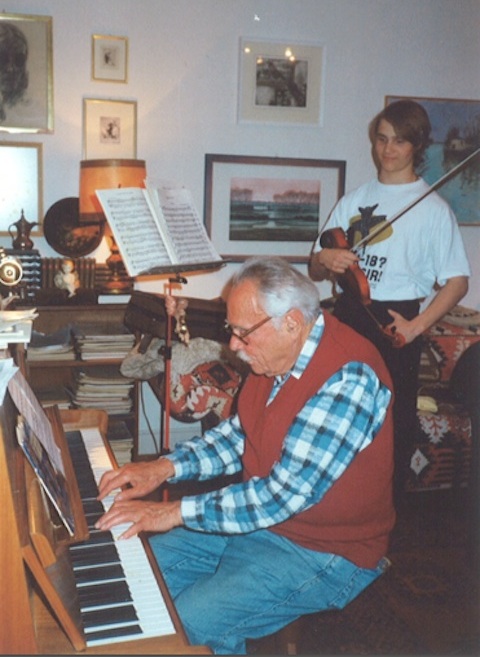
Professor Stanko Bilinski playing piano at home.
Photo by the courtesy of the author of this text.
Behind him Lukas Zett. Information by the courtesy of Dr. Vanda Bilinski.

Predsjednički govor "Utjecaj otkrića neeuklidske geometrije na savremeni razvoj nauke" [S7] započinje zanimljivom napomenom o međusobnoj zavisnosti znanstvenih otkrića i mogućnosti procjene njihova utjecaja.

Radi tijesne povezanosti i međusobne uvjetovanosti naučnih otkrića, pojedinih dijelova nauke i nauke u cjelini, teško da je i moguće govoriti o tome kako je neko naučno otkriće imalo utjecaja na daljni razvoj nauke. Pa ipak, vidljivi trag, što ga je iza sebe ostavilo otkriće neeuklidske geometrije u toku kasnijeg razvoja nauke, tako je nesumnjiv i izrazit, da nije moguće ne zapaziti ga sve do današnjih dana.

U tom radu profesor Bilinski otvoreno iznosi svoje mišljenje o trojici otkrivaća neeuklidske geometrije i svoje gledanje na Gaussovo ponašanje u svezi s otkrićem neeuklidske geometrije. Do otkrića neeuklidske geometrije došao je Gauss još prije rođenja Lobačevskoga i Bolyaja, no za svog života ništa o tom nije objelodanio. Kada mu je njegov školski drug Farkaš Bolyai, otac Janoša, poslao rad svoga sina, Gauss mu je odgovorio, da taj rad sadrži rezultate njegovih vlastitih istraživanja od unatrag 30 do 35 godina, ali da on nije imao namjeru za života ništa od toga publicirati, jer većina ljudi to ne bi prihvatila sa razumijevanjem. Jednom drugom prilikom izjavio je Gauss da se boji vike Beoćana, pa da zato ne će ova svoja istraživanja objaviti.

Mnogi zamjeraju Gaussu ovaj njegov stav. Svojim golemim autoritetom on je mogao učiniti da ove nove i smione ideje znatno ranije steknu opće priznanje i tako ubrzaju razvoj ne samo matematike, nego i tadašnjeg filozofskog shvaćanja svijeta i nauke uopće. Smatraju da u Gaussa nije bilo odvažnosti da se prihvaćanjem novih, revolucionarnih ideja suprotstavi metafizičkoj filozofiji svog vremena i tadašnjem apriorističkom shvaćanju pojma prostora i vremena. Neki opet objašnjavaju ovaj stav Gaussa na drugi način. Tako npr. B. N. Delone u jednom članku o geometriji Lobačevskog kaže u doslovnom prijevodu ovako: "Kod pregleda rukopisne ostavštine velikog njemačkog matematičara Gaussa postalo je sigurno da je i Gauss sa svoje strane došao do istih zaključaka kao i Lobačevski i Bolyai, a očito čak i nešto prije njih, no do konca svog života ništa od toga nije štampao. Ovo se, možda, može objasniti njegovom navikom, da mnogo godina obrađuje svoje radove i štampa ih samo nakon toga, pošto su odležali i pošto ih je svestrano razmotrio, a o takvom principijelnom pitanju, kao što je neeuklidska geometrija, trebalo je svakako dugo razmišljati. No, možda su tu bili i drugi razlozi."

Koji bi to "drugi razlozi" mogli biti, Delone ništa ne kazuje. Meni se čini posve nevjerovatnim da tako velikom učenjaku kao što je bio Gauss ne bi dostajalo hrabrosti i odvažnosti da se suprotstavi krivom shvaćanju svoje okoline, i da joj iznese i prikaže pravu istinu, ukoliko bi u ispravnost svoga shvaćanja bio apsolutno siguran. No, iako je već sam Gauss neeuklidsku geometriju izgradio daleko od njenih osnovnih ideja, i pri tom nije nigdje naišao na neku kontradikciju, ipak ni on, a ni Lobačevski ni Bolyai nisu imali dokaz relativne nekontradiktornosti nove geometrije s obzirom na neku drugu osnovnu opće priznatu nauku. Iako u to vrijeme osnovni principi aksiomatike nisu bili posve egzaktno i eksplicitno formulirani, u svojoj suštini oni su bili sadržani već u filozofskim spisima Aristotela, Platona i drugih grčkih filozofa, pa su tako i u Gaussovo vrijeme u svojoj biti bili opće prihvaćeni. Mislim eto, da je pravi uzrok, da Gauss nije objavio svoje radove iz područja neeuklidske geometrije baš u tome, što radi pomanjkanja dokaza nekontradiktornosti nije imao apsolutne sigurnosti u istinitost svojih ideja. Vjerojatno se nadao, da će do takvog dokaza još tokom života doći, no u tom nije uspio. Prvi takav dokaz dao je tek Felix Klein dvadesetak godina iza Gaussove smrti.

Čini se, ipak, da je od trojice otkrivača neeuklidske geometrije Lobačevski bio onaj, koji je imao najjasniju sliku o dalekosežnosti ideja vezanih uz otkriće ove nove geometrije.

Vratimo se sada članku "Ekonomsko i kulturno značenje matematike" [S6] i navedimo u cjelosti njegov završni dio koji osobito jasno govori o gledanju i mišŒjenju profesora Bilinskog na suvremena matematička kretanja. Istodobno se pokazuje širina gledanja profesora Bilinskog na znastveno djelovanje koje u potpunosti uvažava pravo i na drugačije mišljenje od njegova.

A sad bih želio ukazati na neke pojave u suvremenom razvoju matematike.

Iako smo prije zaključili da apstraktnost matematičkih teorija općenito ne umanjuje njihovu vrijednost i primjenjivost, nego obično tu vrijednost još i povećava, ipak treba istaći da to vrijedi samo uz izvjesna ograničenja.

Poticaj za stvaranje novih matematičkih teorija dolazi najvećim dijelom iz realnog svijeta. No, zadovoljivši časovite potrebe neposredne primjene, struja matematičkih istraživanja se ne zaustavlja. Tako dolazi do sve općenitijih teorija, koje se često puta, istom mnogo godina kasnije u nekim drugim interpretacijama, pokazuju vrlo korisnima, pa čak i čisto praktički primjenjivima. No čini mi se da u suvremenom stvaranju modernih matematičkih teorija ovaj proces ide kadgod predaleko. Uslijed mnogostrukih i uzastopnih generalizacija i posve samovoljnih aksiomatizacija dolazi u modernoj matematici do teorija koje su izgubile svaku vezu s realnošću, bez ikakve nade, da će do te veze jednom opet doći. Takve su teorije posve iskonstruirane, a njihova je vrijednost vrlo malena. One ne daju nikakav prilog spoznaji matematičke strukture svemira, nego - u najboljem slučaju - prilog spoznaji strukture nekih posve posebnih ljudskih misli. Po svojoj naučnoj vrijednosti ovakve se teorije uistinu ne razlikuju mnogo od neke partije šaha ili neke šahovske konačnice. Takva teorija može biti čak i lijepa i dubokoumna, no po pravoj naučnoj vrijednosti takva teorija daleko zaostaje, npr. za nekim i najskromnijim teoremom iz područja elementarne geometrije. Otkriće takvog teorema znači, naime, pobjedu u borbi čovjeka s okolnim svijetom, a svaka je takva pobjeda od trajnog značenja za napredak ljudskog roda.

Ipak, u procjeni vrijednosti pojedinih teorija ne smijemo biti suviše kruti i strogi. Osim subjektivnog intuitivnog osjećaja danas nemamo nikakav sigurni objektivni kriterij, na osnovi kojega bismo mogli donijeti kategorični zaključak o primjenjivosti i konačnoj vrijednosti neke matematičke teorije. Poznata je činjenica, da se danas vrlo korisno primjenjuju mnoge matematičke teorije, za koje se u vrijeme njihovog nastajanja činilo, da su daleko od svake realnosti. Na primjer kad je Riemann prije nekih 100 godina postavljao temelje svoje, tj. Riemannove geometrije, sigurno nije ni slutio, da udara temelje opće teorije relativnosti, pa dakle i temelje cijele moderne fizike. A kad je Boole prije nešto više od 100 godina zamislio svoju, tj. Booleovu algebru, nije imao ni pojma da stvara osnove za teoriju današnjih računskih strojeva.

Iz tih, eto, razloga razumljiva je izjava Felixa Kleina o objektima matematičkih istraživanja. Kad su ga naime zapitali, što treba zapravo matematika da istražuje, odgovorio je, da ona treba istraživati sve što uopće istražiti može.

I doista putovi stvaralačke ljudske svijesti vrlo su složeni, pa bi bio štetan i opasan svaki pokušaj njihovog ograničavanja. Zato smatram da bi i svako suviše usko shvaćeno planiranje naučne matematičke djelatnosti i ograničavanje naučne tematike donijelo više trajne štete, nego časovitih neposrednih koristi. Da bi stvaralačka misao ljudska mogla doseći maksimum svog dometa, ona mora imati osjećaj potpune nevezanosti i apsolutne slobode.

U skladu s rečenim profesor se Bilinski uvijek ponašao, odnosio i djelovao, uključivo i u najužem krugu članova Geometrijskog zavoda, dopuštajući svakom svojem suradniku potpunu slobodu da do kraja samostalno odabere područje znanstvenog djelovanja.

Zauvijek ćemo pamtiti voljenog profesora i učitelja, cijenjenog kolegu i međunarodno priznatog znanstvenika, dragog prijatelja, te uvijek gospodina. Ostajemo mu zahvalni i vjerni, njemu i onome čemu nas je učio, izravno i neizravno, kao matematičar i, povrh svega, kao čovjek.

Neka je hvala i slava profesoru Stanku Bilinskom!

Literatura / izvori

  1. Pavković, -Boris: Stanko Bilinski - Povodom 80. godišnjice života. Istorija matematičkih i mehaničkih nauka (Matematički institut, Beograd) 4 (1991), 71-83.
  2. Stanko Bilinski, Ljetopis JAZU 70 (1965), 185-188.
  3. Spomenica Prirodoslovno-matematičkog fakulteta 1874 - 1974, PMF, Zagreb, 1974.
  4. Vučkić, -Milenko: Nastavni i znanstveni rad na području matematičkih znanosti na Mudroslovnom, Filozofskom i Prirodoslovno - matematičkom fakultetu Sveučilišta u Zagrebu u razdoblju 1876-1976. Stogodišnjica nastave i organiziranoga znanstvenog rada iz područja matematičkih znanosti na Sveučilištu u Zagrebu, PMF-Matematički odjel i Društvo matematičara i fizičara SRH, Zagreb, 1977, 9-51.
  5. Hrvatski biografski leksikon, I. svezak, Jugoslavenski leksikografski zavod, Zagreb, 1983, 766-767.
  6. Stanko Bilinski, Ljetopis JAZU 90 (1987), 424-425.
  7. Hrvatski leksikon, I. svezak, Naklada leksikon d.o.o., Zagreb, 1996, 98.
  8. 120 godina nastave prirodoslovlja i matematike na SveučilišŒtu u Zagrebu PMF, Zagreb, 1996.
  9. Stachel, -Hellmuth: Stanko Bilinski - Nachruf mit Schriftenverzeich- nis. Almanach 1998/99 der Oesterreichischen Akademie der Wissenschaften, Bd. 149 (1999)
  10. Pavković, -B.; Volenec, -V.: In Memoriam: Stanko Bilinski [PDF], Glasnik- Mat.-Ser. III 33(53) (1998), 323-333.
  11. Polonijo, -Mirko: Akademik Stanko Bilinski - In Memoriam. KoG (Konstruktivna geometrija i kompjutorska grafika) 3 (1998), 4-9.
  12. Polonijo, -Mirko: Akademik Stanko Bilinski - značajni hrvatski geometričar. Matka 27 (1999), 159-161.
  13. Polonijo, -Mirko: Akademik Stanko Bilinski - otkrivač drugog rombskog dodekaedra. Matematičko-fizički list 4 (1998-99), 193-194.
  14. Ivanšić, -I.: Djelatnost Društva u proteklih 40 godina - matematika. Glasnik-Mat.-Ser. III 24(44) (1989), 651-653.
  15. Ivanšić,- I.; Mardešić,-S.; Pavković,-B.: Pedeseta obljetnica Društva. Glasnik-Mat.-Ser. III 30(50) (1995), 373-384.
  16. Spomenica u povodu proslave 300-godišnjice Sveučilišta u Zagrebu, Sveučilište, Zagreb, 1969.


Boris Pavković i Vladimir Volenec: In memoriam Stanko Bilinski [PDF], Glasnik- Mat.-Ser. III 33(53) (1998), 323-333.


Rombic polyhedra; published in Matematičko-fizički list, LX 1 (2009. - 2010.), Zagreb, and accompaning the article below.
Many thanks to Dr. Željko Hanjš, editor in chief of the journal, for sending us the photo.

Vladimir Volenec: Rombski izoedri [PDF], Matematičko-fizički list, LX 1 (2009. - 2010.), str. 12-14.

Formated for CROWN by Darko Žubrinić
Distributed by www.Croatia.org This message is intended for Croatian Associations/Institutions and their Friends in Croatia and in the World. The opinions/articles expressed on this list do not reflect personal opinions of the moderator. If the reader of this message is not the intended recipient, please delete or destroy all copies of this communication and please, let us know!


Branko Grünbaum 1929—2018 distinguished American mathematician born in Croatia

By Nenad N. Bach and Darko Žubrinić
Published  11/17/2018


Professor Branko Grünbaum (source of the photo Northewest Science and Technology)


Branko Grünbaum 1929-2018 distinguished American mathematician born in Croatia

Branko Grünbaum was born in 1929 in the city of Osijek, Croatia. He started his studies at the University of Zagreb, and then moved in 1949 to Israel, where he completed his studies in 1954 and earned his PhD at the Hebrew University in Yerusalem in 1957. In 1966, he became full professor at the the University of Washington, after spending time at the Institute for Advanced Studies in Princeton, Hebrew University and at the Michigan State University.

Some of his classic monographs are Convex Polytopes and Tiles and Patterns (the latter written wwith Shepherd). A copy of the monograph Tiles and Patterns has been donated by Professor Grünbaum to the Mathematics Department of the University of Zagreb, with his signature. His main interests in Mathematics are in patterns, tilings, and geometric shapes called convex polytopes.


Professor Branko Grünbaum (source of the photo Wikipedia)


Professor Grünbaum is recipient of the prestitious Steel Prize from the American Mathematical Society in 2005. He is a foreign member of the Croatian Academy of Sciences and Arts in Zagreb since 1988.

He was happily married for 61 years to his high-school sweetheart Zdenka (Bienenstock) Grünbaum, who died in 2015.

According to personal information by Professor Ivan Ivanšić, a recommendation letter for then young Branko Grünbaum for the continuation of his studies at the Hebrew University of Yerusalem was written by Danilo Blanuša, distinguished Croatian mathematician, who was also born in the city of Osijek as Branko Grünbaum.

Branko Grünbaum was fluent in five languages, including Croatian.

Branko Grünbaum wrote a very interesting survey paper "The Bilinski dodecahedron, and assorted parallelohedra, zonohedra, monohedra, isozonohedra and otherhedra" ([PDF], 27 pp.), dealing with the work of distinguished Croatian mathematician Stanko Bilinski. For more details, see an article dealing with the Bilinski dodecahedron and the life of Stanko Bilinski, who was a full member of the Croatian Academy of Sciences and Arts in Zagreb.

According to Dr. Vanda Bilinski, daughter of Professor Billinski, Branko Grünbaum started his study of Mathematics at the University of Zagreb, and her father was was lecturing to him as a freshman. It is very probable that it was Professor Bilinski who kindled his interest in Geometry.


Many thanks to Professor Ivan Ivanšić, University of Zagreb, for his information about the death of Professor Branko Grünbaum.


Wavelet Theory

Alex Grossmann 1930-2019 distinguished Croatian-French mathematician a founder of Wavelet Theory

By Nenad N. Bach and Darko Žubrinić
Published  05/14/2021

Born in Croatia's capital Zagreb, studied Physics and earned his PhD at the University of Zagreb in 1955


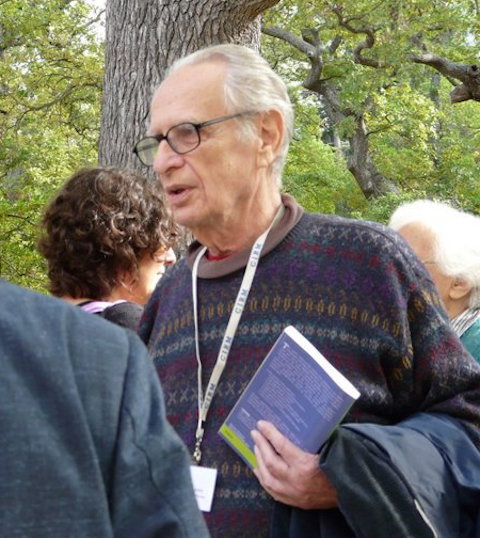
Alex Grossmann lecturing at CIRM in 2011. Photo from an article by his former
PhD student Professor Ingrid Daubechies, who is also one of the founders of Wavelet Theory.


Summary. Alex Grossmann (Alexander, Alexandre) was born in the city of Zagreb, where he completed his studies of Physics at the University of Zagreb, and earned his PhD in 1955, at that time employed at the Ruđer Bošković Institute in Croatia's capital. He spent the period between 1955 and 1965 in the USA, working among others at the Insitutute of Advanced Study, Princeton, and at the Courant Insitutue of Mathematics, NY. Since 1965 he was employed at the University of Marseille in France. This Croatian-French mathematician is considered as a father of Wavelet Theory, due to his groundbreaking joint work with French geophysicist Jean Morlet in 1984. He was a thesis advisor to distinguished Belgian physicist and mathematician Ingrid Daubechies.


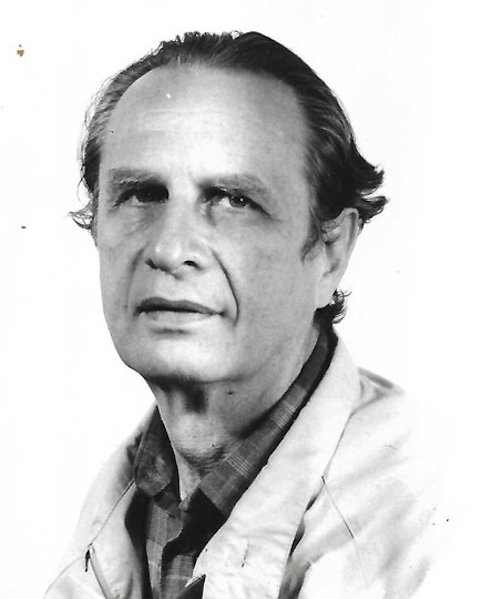
Alex Grossmann (1930-2019)

Born in 1930 in Croatia's capital Zagreb, Alex Grossmann completed his study of Physics at the University of Zagreb in 1952, and earned his PhD in Physics in 1955 at the Ruđer Bošković Institute. Both his diploma work and PhD were completed under Ivan Supek. (Supek completed his PhD under Werner Heisenberg in 1940 in Leipzig, Germany.) Grossmann was employed as an assistant at the Institute of Physics in Zagreb (as well as then young Gaja Alaga and Vladimir Glaser, distinguished Croatian physicists).

Alex Grossmann in 1950, when he was a student of Physics at the University of Zagreb.
Photo from Centre de Physique Theorique, Marseille.

Then he moved to the United States, where he was employed at the Brandeis University near Boston, at the New York University (Courant Institute of Mathematical Sciences), and at the Institute of Advanced Studies in Princeton, until 1964.

After his one-year sojourn at IHES (Institute des Hautes Etudes Scientifiques) in Bures-sur-Yvette in France, at the request of Daniel Kastler he started his very fruitful work at the University of Marseille in 1966, in the fields of Mathematical Physics and Wavelet Theory.

Alex Grossman in 1978.
Photo from Centre de Physique Theorique, Marseille.
Alex Grossmann in 1980. Photo from Centre de Physique Theorique, Marseille.

In 1980, he started his important collaboration with French geophysicist Jean Morlet, which has resulted in laying down the mathematical foundations of Wavelet Theory in 1984. Their work is cited in enormously many papers and books, covering practically all scientific areas imaginable (see the above link). In 2020 only, their joint work (published 36 years earlier in SIAM Journal of Mathematical Analysis) was cited in nearly 120 references! (Here, SIAM = Society for Industrial and Applied Mathematics.) The overall number of citations until May 2021 for this paper only was 1990 (information by ac. Andrej Dujella, based on the Web of Science).

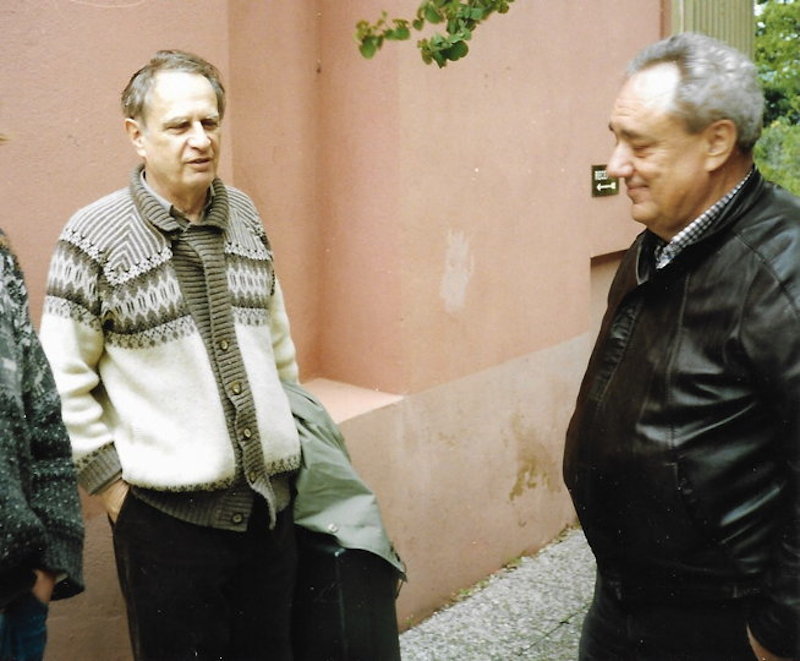
Alex Grossmann at a conference.
Photo from Centre de Physique Theorique, Marseille.

In 1986, Alex Grossmann founded and directed international Wavelet Research Group (in French, GDR "Ondelettes").


Alex Grossmann in 1990s.
Photo from Centre de Physique Theorique, Marseille.

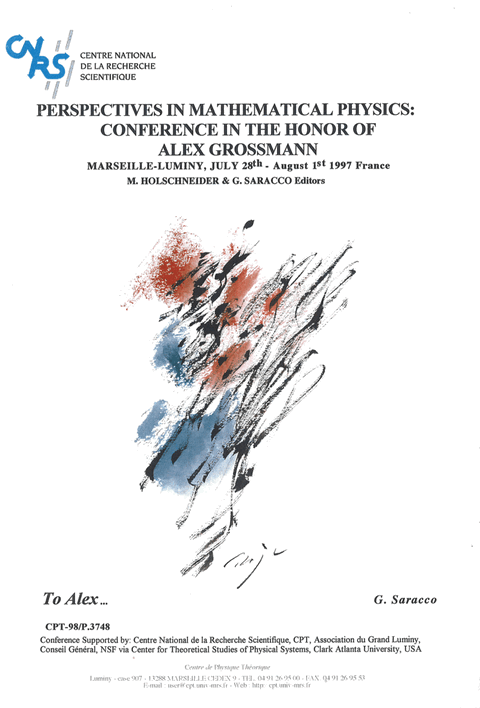
In 1997, an international conference was organized by the Center of Theoretical Physics in Marseille in his honor:

Perspectives in Mathematical Physics:
Conference in honor of Alex Grossmann; see [PDF].

In 1997, Alex Grossman obtained a Special Prize (Prix Special) from the French Physical Society.

Since 1993, his interests were oriented towards Mathematical Biology (genome problems and interplay with Computer Science). In 2000, he delivered a plenary lecture at the 2nd Congress of Croatian Mathematicians in his native city of Zagreb, upon the invitation of Professor Hrvoje Šikić. The title of his talk was "Comparisons of biological sequences: some tools from linear algebra."

Grossmann was a member of Advisory Board of Glasnik matematički (published by Croatian Mathematical Society in Zagreb) in the period of 2002-2006

In 2009, Alex Grossmann was elected a member of Academia Europea, in section Physics and Engineering Sciences. His research area was indicated as Mathematical Physics.

In 2019, an international conference was organized in Orsay near Paris, in honor of Alex Grossmann and Yves Meyer: Wavelets and Beyond - A celebration for Alexandre Grossmann and Yves Meyer.

Alex Grossman's father was Jewish (Maks Grossmann, distinguished Croatian medical expert), and his mother was Croatian (Marija Ivana Horvat; her father was Aleksandar Horvat, and it seems that his name was given to her son with Maks).

Alex Grossmann with Jean Morlet in 1991
Photo from Centre de Physique Theorique, Marseille.
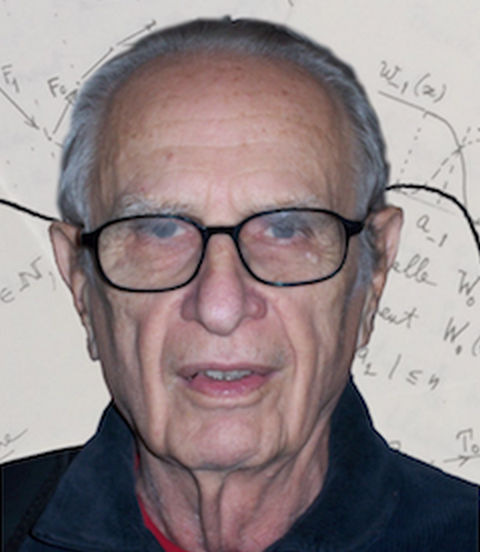
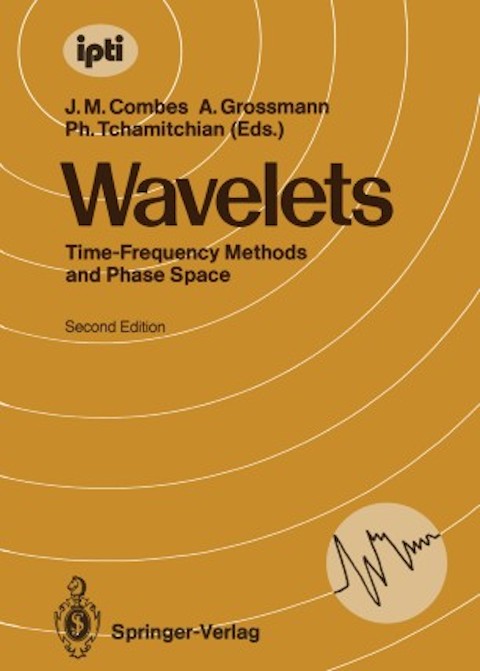
Professor Alex Grossmann. Photo from


Wavelets, published by Springer-Verlag,
based on the conference organized in Marseille in 1987.

A wide range of mathematical contributions of Alex Grossmann can be grouped into the following three main areas:

  • quantum mechanics, noncommutative algebra, Field Theory in Physics, disordered media, quantum Hall effect, Statistical Physics, Antenna Theory,
  • wavelet analysis and numerous applications (signal analysis and resynthesis, pattern recognition, image compresson - including JPEG2000, analysis of fractals, potential theory, geophysics, study of turbulence, detection of gravitational waves, music composition, psychoacoustics, etc.),
  • Mathematical Biology, and in particular Genetics, Genomics and Bio-informatics.

A result of his work at the Center of Theoretical Physics in Marseille (CPT - Centre de Physique Theorique) is that the logo of CPT was chosen to be dedicated to wavelets, an area in which this institution became universally recognizable:


Ingrid Daubechies, distinguished Belgian physicist and mathematician, one of the founders of Wavelet Theory, delivered a lecture in 2020 dedicated to Alex Grossmann. He was her thesis advisor in Theoretical Physics, along with Jean Reignier. She defened her PhD in 1980.

Marie Farge, Alex Grossmann, Yves Meyer, Thierry Paul, Jean-Claude Risset, et al.: Les ondelettes et le CIRM [PDF]. Gazette des Mathematiciens, Societe Mathematique de France, 2012, 131, pp. 47-57. hal-01136298

We mention a joint paper of Alex Grossmann with Ingrid Daubechies (first female president of International Mathematical Union) and Yves Meyer (recipient of the prestigious Abel Prize in 2017):

Daubechies I., Grossmann A., Meyer Y., 1986: Painless nonorthogonal expansions, Journal of Mathematical Physics, 27(5), 1271-1283

In early 1980s, Alex Grossmann was visited in Marseille by then young Croatian mathematician Andro Mikelić (1956-2020), distinguished expert in Mathematical Physics. He spoke fluently his native Croatian language until the end of his life. He was a fascinating polyglot.


Behind the Scenes of the Wavelet Revolution
INGRID DAUBECHIES - LETTERS TO YVES MEYER

With an introduction by Yves Meyer

Mathematical Sciences Publishers,
University of California, Berkeley, 2020

Yves Meyer in his Introduction wrote the following (pp. 7 and 8):

... The story I am telling now began on January 15, 1985, when I met Alex Grossmann in Marseilles for the first time. A month earlier Jean Lascoux, a physicist and a colleague at Ecole Polytechnique, had given me a fascinating preprint by Grossmann and Morlet. This preprint was so attractive that I could not resist traveling to Marseilles. I spent three days talking with Alex and I soon became his disciple. I shared his values and ethics. Among these values I would single out an intense curiosity, a great humility, and profound confidence in others and an outstanding capacity for friendship. Alex became a spiritual father and a scientific guide. ...

Source [PDF]. Many thanks to Professor Hrvoje Šikić for this information

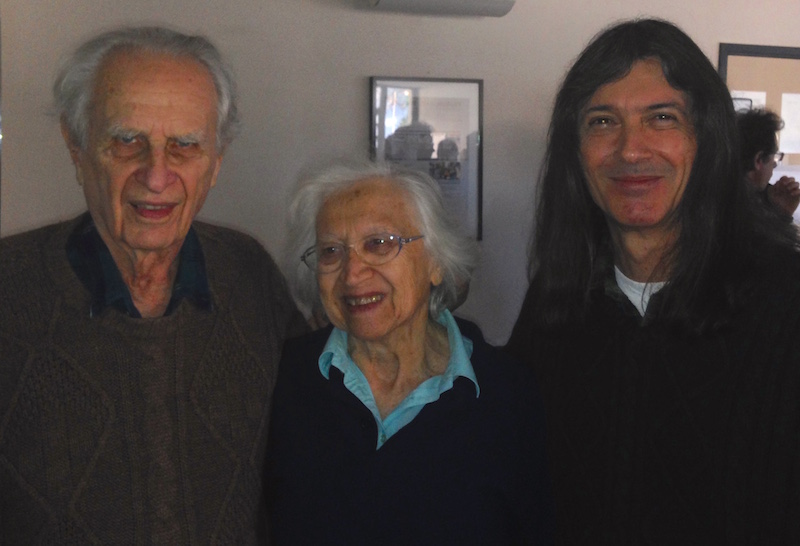
Alex Grossmann with his wife Dickie and with Richard Kronland-Martinet,
Research Director at the Laboratoire de Mecanique et d'Acoustique, Aix/Marseille Universite, CNRS, Centrale Marseille, France.
Here, CNRS = Centre National de Recherche Scientifique = National Center for Scientific Research.
Source of the photo.

The very first film on wavelets (ondelettes) that Richard Kronland-Martinet made jointly with
Alex Grossmann and Jean Morlet. The commentary (voice-over) is entirely by Alex Grossmann:


This movie was presented during the first workshop on wavelets in Pau (France) in November 1986.


Lecture by Richard Kronland-Martinet delivered in 2015, dealing with applications of Wavelet Theory in Computer Music.
1:35 ... and such a special experience would not have been possible without a very special man, and since Alex is here, Alex Grossmann,
I would like Alex once again thank you for - what can I say? - for being what you are...

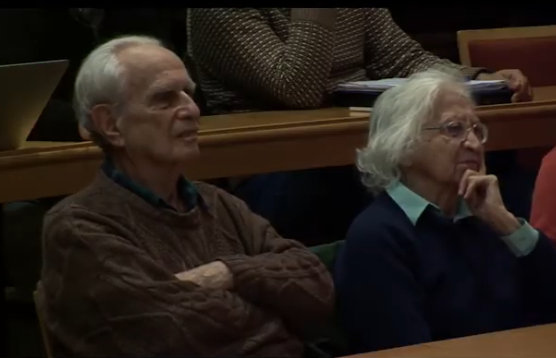
6:05 Alex Grossmann with his wife, listening to this very interesting lecture.

Two screenshots of the above video: Alex Grossmann with his wife during the lecture (above),
Jean-Claude Risset (scientist and composer) and Alex Grossmann arround 1985 (below).

In the period from 1990 till 2015 (i.e., in just 25 years) about 500 PhD theses were listed related to the topic of wavelets! See [JPG].

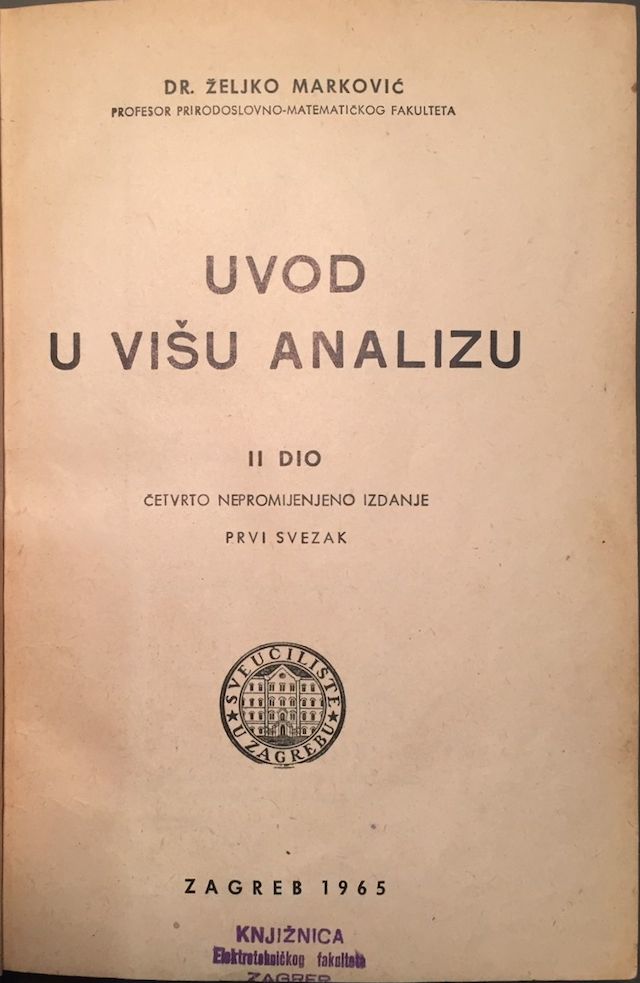
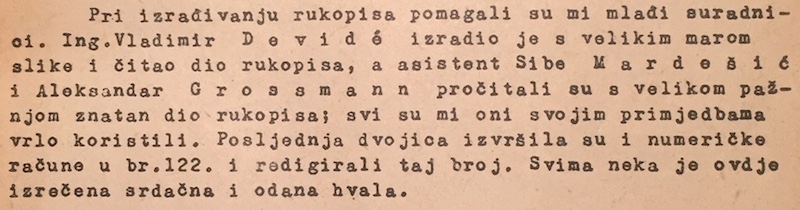
The title page of Introduction to Higher Analysis (Vol 2, Part 1) by academician Željko Marković, published in 1965
at the University of Zagreb. Many thanks to the Library of the Faculty of Electrical Engineering and Computing.

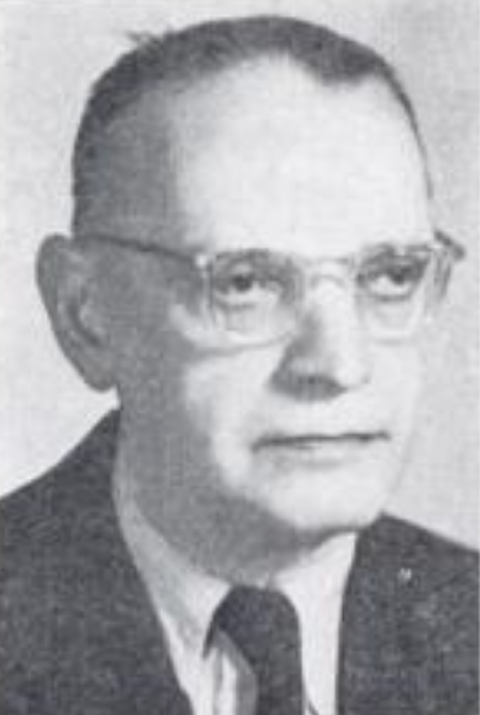
Željko Marković, mathematician and historian of mathematics, University of Zagreb
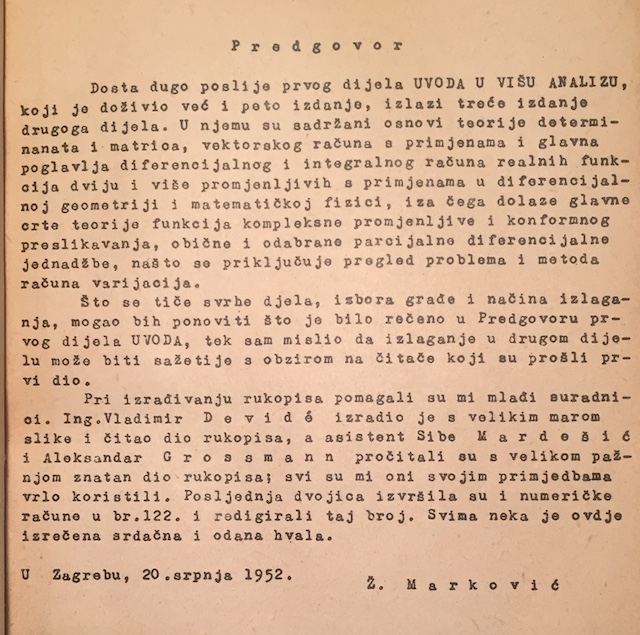
Preface to Vol 2, Part 1, written by ac. Željko Marković in 1952. The names of his then young collaborators
Vladimir Devide (1925-2010), Sibe Mardešić (1927-2016), and Aleksandar Grossmann
(who have read with great care a considerable part of the manuscript) are mentioned in the last paragraph.
The last two (i.e., Mardešić and Grossmann) completed numerical calculations in Section 122 of the book
(contained in Vol 2, Part 2), dealing with Numerical solving of differential equations, and revised that section.
Professor Marković expresses all of them his hearty and devout thanks.


Acknowledgments. Many thanks to Professor Ibrahim Aganović for his information about Grossman's PhD mentor Ivan Supek.
Also many thanks to Professor Richard Kronland-Martinet.

Theory of Groups

Zvonimir Janko, discoverer of four sporadic groups, J1, J2, J3, and J4

Zvonimir Janko (1932-2022), oustanding Croatian mathematician

Topology

Sibe Mardešić 1927-2016 distinguished Croatian mathematician and Fellow of the AMS

By Nenad N. Bach and Darko Žubrinić
Published  06/18/2016

Member of Croatian Academy of Sciences and Arts and a Fellow of the American Mathematical Society


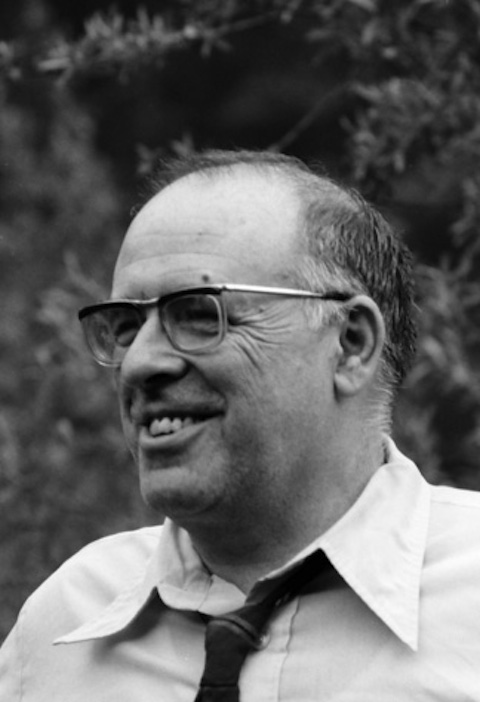
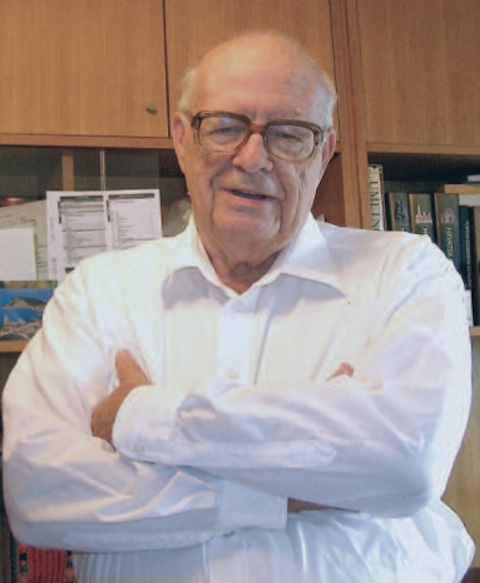
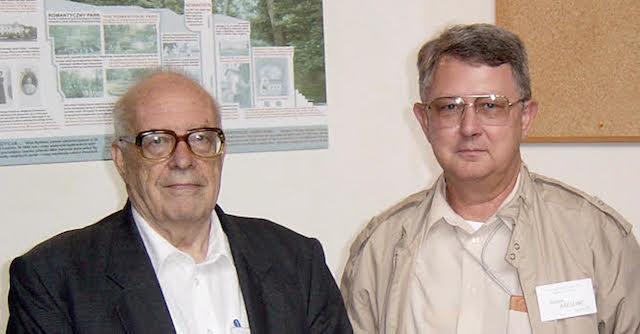
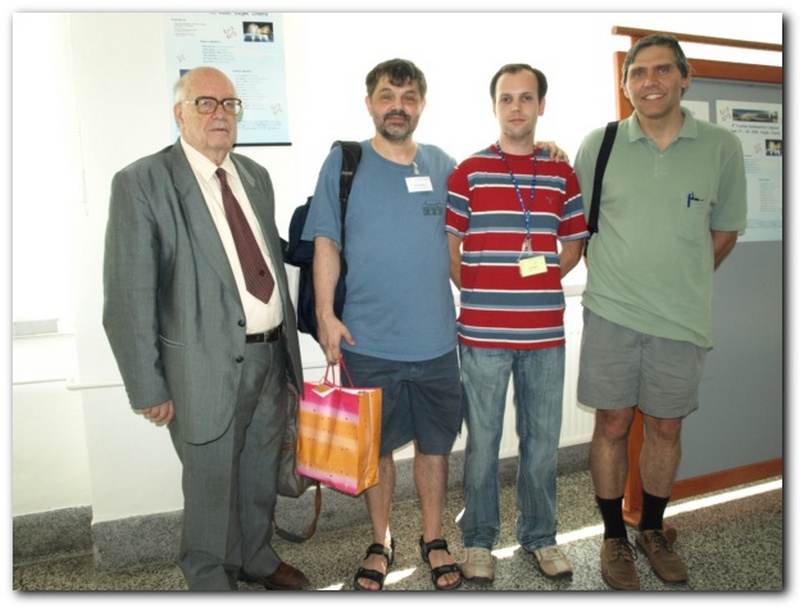
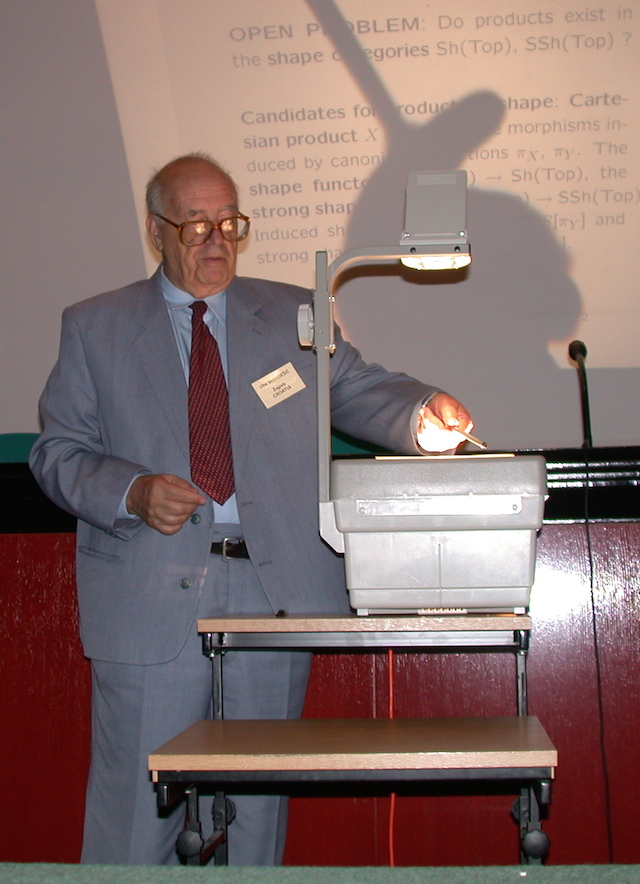
Professor Sibe Mardešić, distinguished international expert in the field of General and Algebraic Topology. Photo by Željko Vojković.


AN INTERVIEW WITH SIBE MARDESIC

James Keesling, University of Florida, USA

Sibe Mardesic is a mathematician who has had a considerable influence on research in topology in the course of his career. It is my pleasure not only to know his mathematics, but also to know him personally. His manner is just as attractive as his mathematics. He is personable, gracious and unassuming. We have a joint paper together and he is the ideal collaborator. His clear mathematical mind and congenial manner made working together a very gratifying experience for me. When we began our work he had a clear idea what results could be expected and what tools would be useful. He also knew that the devil was in the details and was never satisfied until every step of each proof was absolutely clear.

Sibe has attained preeminent stature, but that was not the sort of thing that he set his sights on. His focus was always on mathematics itself and the beauty he saw in it. As he says in our interview, Some questions would just attract my imagination and I would follow that trail persistently and for an extended period of time. By hard work and good results he showed that certain areas of mathematics were fruitful. In so doing he prepared the way for others to follow. Those who did have much to be grateful for.

At the end of the interview there is a biographical sketch which includes Sibe's major accomplishments and some of the recognition that he has been accorded. Please do not think that this is the final chapter in the life of Sibe Mardesic. He is still active and there is more to come.

Sibe, tell us about your family.

The family on both, my father's side (Mardesic) and my mother's side (Karaman), is from Dalmatia, the coastal region of Croatia. Presence of the Mardesices in Komiza on the island is documented since 1539. They fished sardine and cultivated grapevine. My grandfather Sibe spent 30 years as lighthouse keeper on remote islands of the Adriatic. My father Pavao was a naval architect and a mechanical engineer. My mother Anka comes from a family of merchants from the coast town of Split and its hinterland.

I understand that your family spent time in different countries while you were growing up. Tell us about this experience.

My father studied at the well-known Technical University in Vienna. The period from 1923 to 1929 my parents spent in Hamburg, where I was born on June 20, 1927 in Bergedorf, a suburb of Hamburg. In 1929 we moved to Chile, where my father worked in a factory near Antofagasta. We returned to Split in 1930 and this concludes my childhood traveling. My parents, beside their mother tongue Croatian, spoke fluently Italian, German, French, English and Spanish. This gave me a good start and enabled me to get pretty good in these languages and Russian.


Sibe Mardešić as a child. Source [PDF].

When were you first attracted to mathematics? Did your parents or other family members play any role in encouraging this pursuit?

My father wanted me to become an engineer and paid particular attention to my school grades in mathematics. Towards the end of the Second World War I joined the Yugoslav Navy, where I worked in the Meteorology Service. There I met a student of mathematics of the University of Zagreb, Mr. B. Makjanic, who later became a known meteorologist. He introduced me to mathematics beyond the school level. I was fascinated by what he told me about sets and their cardinal numbers and I made the decision to study mathematics as soon as I got released from the Navy.


Sibe Mardešić in 1948. Source [PDF].

Who were the teachers and others that had the most influence on you in choosing the direction of your studies?

I enrolled at the University of Zagreb in 1946/47. At that time there were few professors at the Mathematics Department. I was attracted to set theory by Prof. Dj. Kurepa and to geometry by Prof. R. Cesarec.

How did you happen to go into topology? What influenced the direction of your research in this field?

Shortly after obtaining my B.Sci. in 1950, I became assistant to Prof. Zeljko Markovic. In his youth he spent a year in Paris and was fascinated by the work of H. PoincarĂŠin celestial mechanics. He wanted me to become interested in dynamical systems, and it was clear to him that to do global analysis one needs a good understanding of topology. Therefore, he suggested that I first study "Lehrbuch der Topologie" by H. Seifert and W. Threlfall. This turned out to be very good advice. I read the book in great detail and fell in love with (algebraic) topology. In my Ph. D. thesis I considered some problems of K. Borsuk concerning homology of function spaces. In the process of writing the thesis I corresponded with S. Lefschetz, who at some point suggested that I visit the Institute for Advanced Study in Princeton. With letters of recommendation by Borsuk, Eilenberg and Kuratowski, I was accepted to the Institute, where I spent the years 1957/58 and 1958/59. In Princeton I attended lectures by R. H. Fox, J. Milnor, J. Moore, N. Steenrod and G. Whitehead and I became a topologist.


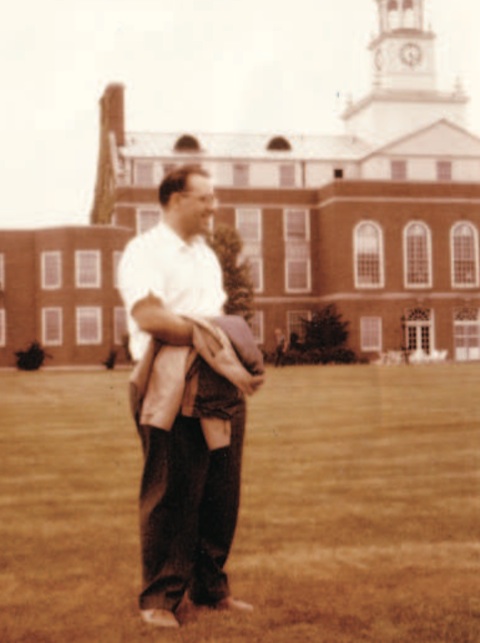
Sibe Mardešić in front of the The Institute for Advanced Study in Princeton,
New Jersey, USA. Source [PDF].

You are not alone in your family as a mathematician. Your wife Vera is also a mathematician. How did the two of you meet? You have had a long and happy marriage. Did your common interests in mathematics help contribute to this?

It was most fortunate for me that I met Vera. This happened in 1948/49, when I was a junior and she was a freshman. Throughout my life I always had her full support. She understood how important my work was to me and she provided a happy and secure environment for me. The fact that she is herself a mathematician enabled her to follow my work and accompany me on many of my mathematical trips. She did most of her work under the guidance of Prof. Victor Klee.

I understand that your son Pavao is also a mathematician. What field is he in? Did your daughter Milica also pursue mathematics?

My son Pavao is indeed a mathematician. He has a B. Sci. and a M. Sci. from Zagreb and a Ph. D. from UniversitĂŠde Bourgogne, Dijon, France, where he now has a position. His area is dynamical systems, in particular, singularities of polynomial vector fields in the plane. My daughter Milica has a Ph. D. in linguistics from Zagreb. We have five grandchildren, from 10 to 3 years old, which give us a lot of joy and pleasure.

What do you see as the highlights of your career in research? What contributions would you like to be most remembered?

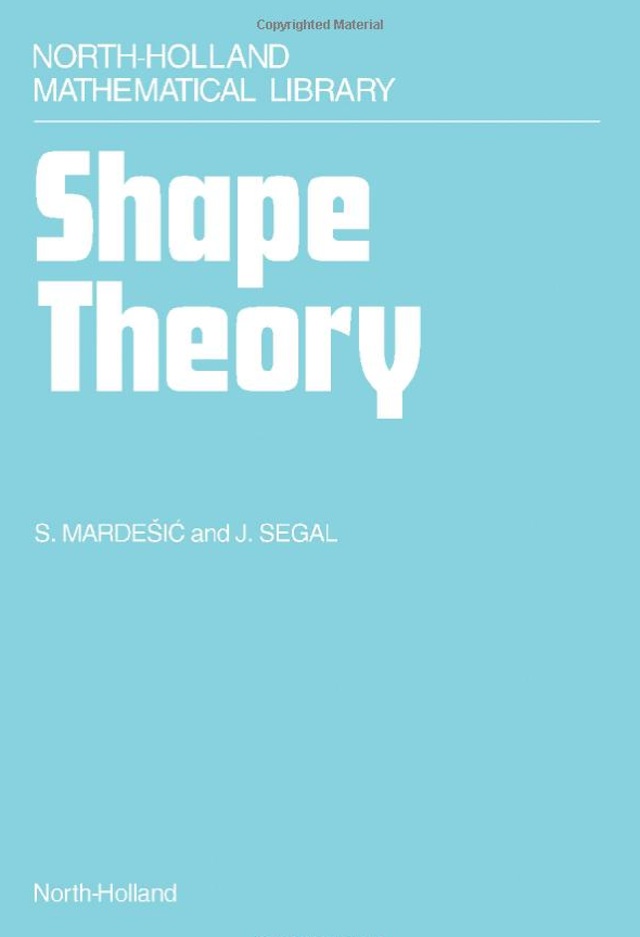
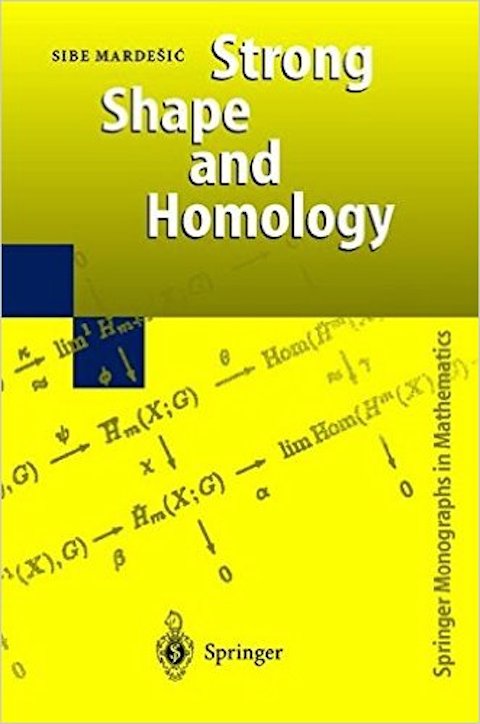
It appears that my most successful result is the factorization theorem in dimension theory, which is quoted in most books on dimension theory. I like my work on continuous images of ordered continua. I believe that I will be remembered for my contributions to shape theory and strong homology. My shape theory book with Jack Segal has been well received. I have a new book on strong shape and Steenrod homology which is in preparation. I am hoping that it will be received as well as the shape theory book has. I also like my work with L. Rubin and T. Watanabe on approximate inverse systems. I always wanted to be an algebraic topologist, but did not quite succeed. Therefore, I like my recent results concerning higher derived limits of homological progroups.

You have had a tremendous influence in building the Mathematics Department at Zagreb. There are no doubt many young mathematicians who are in departments that are building. As one who has been very successful at this, what advice would you give?


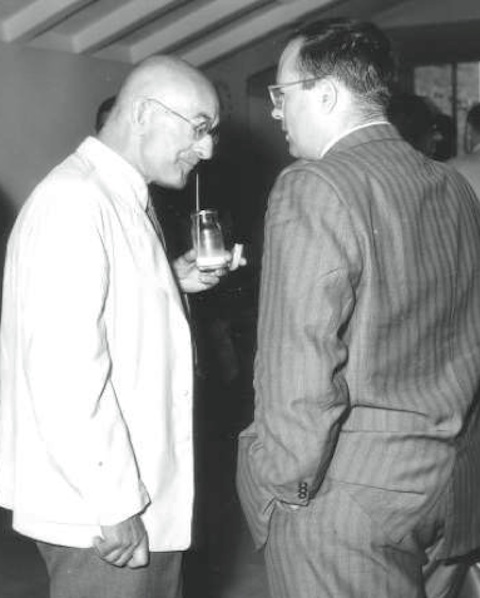
Sibe Mardešić with Pavel S. Aleksandrov, distinguished Russian mathematician.
Source [PDF].

I have been very devoted and faithful to Mathematics in Zagreb. I dedicated approximately equal shares of my time and energy to research, teaching and organization. I tried to transfer to Zagreb good things that I saw at other more developed places. I paid particular attention to teaching at the graduate level.

Several of our graduate students at the University of Florida have come from Zagreb. They were deeply influenced by your teaching. Do you have a special philosophy or methodology in your teaching? Many of us envy the profound influence you have had as a teacher. Could you help us with some practical insights?

I first try to understand the material properly. Then I try to present it clearly, giving the necessary background. Enthusiasm of the teacher and an honest, respectful and friendly approach to students are essential features of successful teaching.

I am sure that there are many young students and mathematicians contemplating their futures right now who would like to know what direction to go. Do you have any thoughts about the future of topology and mathematics in general that might be helpful to them?

I never thought very much about the direction in which I was going. Some questions would just attract my imagination and I would follow that trail persistently and for an extended period of time. The internal beauty and consistency of a result is what always mattered to me.

We have all been saddened by the events in the former Yugoslavia. As you know my step-father's family came from Croatia, so I also have a sense of personal distress in what has happened. Are there steps that the mathematical community can take to help bring stability? What can we do to help mathematics prosper in this region?

I was deeply shaken by these events. Fortunately, unlike many others, my own family was spared from personal tragedies. I hope that the situation in my country will gradually stabilize. It is now important that we resume the excellent ties which we had before with our colleagues abroad. Let us be in touch through mail, visits and common programs. It would be nice if we could together revive the Dubrovnik topology meetings. I wonder if there would be a way to help us fill up the gaps in our library which occurred during the war.

Sibe, as one who has admired your work for many years, it was a privilege for me to interview you for Topology Atlas on the web. Thank you for the interview and for your continuing contributions to topology.


Sibe Mardesic - Biography

Education

Elementary and high school in Split (Croatia). B. Sci. in Mathematics 1950 (Faculty of Natural Sciences and Mathematics, Zagreb), Ph. D. in Mathematical Sciences 1957 (University of Zagreb). Ph. D. Thesis: Homology properties of some function spaces. Habilitation (Faculty of Natural Sciences and Mathematics, Zagreb) 1960. Habilitation Thesis: On covering dimension and inverse limits, Illinois J. Math. 4 (1960), 278-291.


Sibe Mardešić is a member of Academia Europaea (The Academy of Europe)

Academic Career

Faculty of Natural Sciences and Mathematics, Zagreb: Asst. 1951, Asst. Prof. 1960, Associate Professor 1962, Professor 1966. Retired 1991. Chairman of the Mathematics Department, Faculty of Natural Sciences and Mathematics, Zagreb, 1961/62; Vicedean, Faculty of Natural Sciences and Mathematics, Zagreb, 1964/65; President of the Council of Faculty of Natural Sciences and Mathematics, Zagreb, 1966/67; Dean of Faculty of Natural Sciences and Mathematics, Zagreb 1974/75 and 1975/76; Dean of the Mathematics Department of Faculty of Natural Sciences and Mathematics, Zagreb 1983/84; Head of the Chair for Topology of the Mathematics Department of Faculty of Natural Sciences and Mathematics, Zagreb, from 1978 to 1982. Head of the Graduate School for Mathematics of the University of Zagreb from 1960 to 1971; Editor in chief of the journal Glasnik matematicki from 1963 to 1976; Member of the Advisory boardof the journal Topology and its Applications since 1971. President of the Croatian Society of Mathematicians and Physicists 1971-1974. Organizer of several international conferences and schools (Dubrovnik 1976, 1981, 1986).

Visiting Appointments

Visiting Member of the Institute for Advanced Study, Princeton, N.J., 1957/58 and 1958/59; Visiting Lecturer, University of Washington, Seattle 1965/66. Visiting Professor, University of Heidelberg, 1971/72; Visiting Professor, University of Pittsburgh, Fall Semester 1972/73; Visiting Professor, University of Utah, Salt Lake City, Fall Semester 1977/78; Visiting Professor, University of Kentucky, Lexington, Spring Semester 1977/78; Visiting Professor, University of Washington, Seattle, Spring Semester 1987/88 and Fall semester 1988/89; Research programs and series of lectures in the duration of one month approximately at the following universities: L'Aquila (1979), Tsukuba (1981), Perugia (1985 and 1990), Oklahoma (1987), Milano (1993).

Publications

Areas of primary interest: Topology, in particular, inverse systems, dimension theory, shape theory and homology theory. 124 published research papers, 19 professional papers and 3 books. Papers published in various journals including: Topology and its Applications, Topology, Fundamenta Mathematicae, Transactions of the American Mathematical Society, Proceedings of the American Mathematical Society, Bulletin of the American Mathematical Society, Comptes Rendus de l'Academie Paris, Doklady Akademii Nauk SSSR, Michigan Mathematical Journal, Illinois Mathematical Journal, Pacific Mathematical Journal, Rocky Mountains Mathematical Journal, Bulletin of the Polish Academy of Sciences, Uspehi Matemativ ceskih Nauk, Tsukuba Journal of Mathematics, Mathematica Japonica.


Sibe Mardešić. Source [PDF].

Reviews and Lectures

Almost 500 reviews for international reviewing journals (Mathematical reviews and Zentralblatt fĂźr Mathematik). Over 260 lectures at conferences and universities in 20 countries. Undergraduate courses in Mathematical Analysis and Topology. 13 different Graduate courses in Topology.

Societies and Recognition

Associated Member of the Yugoslav (Croatian) Academy of Sciences and Arts 1975; Member of the Yugoslav (Croatian) Academy of Sciences and Arts JAZU (HAZU) 1988; Member of Academia Europaea 1990. Member of the American Mathematical Society since 1958; Member emeritus of the American Mathematical Society since 1992. Professor emeritus of the University of Zagreb, 1996. Award for Scientific achievements of the Republic of Croatia Rudjer Bošković 1964, Work Medal with Golden Wreath 1975, Award of the City of Zagreb 1978, Award for Life Achievements of the Republic of Croatia 1990.

James Keesling


Interview from Volume 1, #3 of TopCom
Source at.yorku.ca; published in 1996.

Many thanks to Professor James Keesling for his kind permission to publish his interview for the readers of the CROWN. D.Ž.

The interview has been translated into Croatian by Dr. Željko Hanjš, University of Zagreb:

James Keesling: Intervju s akademikom Sibom Mardešićem [PDF], Matematičko-fizički list, Zagreb, 2008.-2009., str. 156-158.

Many thanks to Branimir Dakić, prof., Zagreb, for kind permission to reproduce some of the photos from his article [PDF] published in Matematika i škola no. 41, 2007.


Professor Sibe Mardešić, University of Zagreb, Croatia, and Professor James Keesling, University of Florida, Gainsville USA,
at a Topology Conference in Bedlewo, Poland, July 7, 2005.

Mathematics geneaology of Sibe Mardešić


Sibe Mardešić: Kako sam postao i ostao matematičar (60 min.), Zagreb 2011.


Topological Seminar in Zagreb, 1999:
Professors Zvonko Čerin, Krešo Horvatić, Leonhard Rubin (University of Oklahoma, USA), Sibe Mardešić, Vera Tonić (University of Rijeka), Sonja Štimac,
Ivan Ivanšić, Šime Ungar and Nikola Koceić Bilan (University of Split, many thanks for the photo).

In Osijek, Croatia 2008, at the 4th Croatian Mathematical Congress:
professor Mladen Bestvina on the right, on the left academician Sibe Mardešić, distinguished Croatian topologist.
Next to him Ivan Mirković, Croatian-American mathematician, professor at the University of Massachusetts, Amherst, MA., USA.
Both Mladen Bestvina and Ivan Mirković were students of Sibe Mardešić at the University of Zagreb.


Sibe Mardešić: Shape Theory [PDF], Proceedings of the International Congress of Mathematicians, Helsinki 1978
Professor Mardešić had the honor of participating at that Congress as invited lecturer in Section of Topology.


Sibe Mardešić and Jack Segal: Shape Theory

Springer Monographs in Mathematics, 2000


Celebration of the 80th anniversary of Professor Ivan Ivanšić in 2011, a close collaborator of Professor Sibe Mardešić,
organized at the Faculty of Electrical Engineering and Computing
of the University of Zagreb


Akademik Sibe Mardešić, međunarodno poznati hrvatski topolog, u polsatnom predavanju opisao je
glavne matematičke rezultate dugogodišnjih istraživanja profesora Ivana Ivanšića.


Akademik Sibe Mardešić, [MP3], 35 min., opisao je znanstveni rad profesora Ivana Ivanšića u pet područja:

  • PL-topologija (po dijelovima linearna topologija, piecewise linear topology)
  • Teorija oblika
  • Slabi fibranti
  • Teorija proširenja
  • Univerzalni prostori


Akademik Sibe Mardešić opisuje Ivanšićev teorem o komplementima iz teorije oblika:

ShX=ShY⟺I∞∖X≈ I∞∖X


Akademik Sibe Mardešić: Radovi profesora Ivanšića u području topologije spadaju među najvažnije koje je dala ova sredina.

U prvom redu profesori Nikica Uglešić, Sibe Mardešić i Vesna Županović, u trećem profesori Mirko Primc i Hrvoje Kraljević.


Akademik Sibe Mardešić sa suprugom Verom u društvu sa svojim nekadašnjim studentima,
profesorima Vesnom Županović i Nikicom Uglešićem u Crnoj vijećnici FER-a.


Akademik Sibe Mardešić: Životni put akademika Vladimira DevidĂŠa (1925.-2010.) [MP3], 2011., predavanje održano u Hrvatskoj akademiji znanosti i umjetnosti


Sibe Mardešić: Vode i more otoka Visa; 2012.


Sibe Mardešić reporting about his current research at the Geometric Topology II Conference in Dubrovnik, 2002

Professors Dragutin Svrtan, University of Zagreb, and Damir Vukičević, University of Split, with academician Sibe Mardešić,
distinguished Croatian topologist, who celebrated his 85th brithday in 2012 during the 5th Croatian Mathematical Congress in the city of Rijeka.


Sibe Mardešić kao gost Matematičkog kolokvija u Osijeku godine 2006.


Akademik Sibe Mardešić i akademik Zvonimir Janko 2009. g. na FER-u, tijekom proslave
90. obljetnice Zavoda za primijenjenu matematiku.

Akademik Sibe Mardešić, akademik Zvonimir Janko, prof.dr.sc. Vladimir Ćepulić

Prof.dr.sc. Juraj Šiftar i akademik Sibe Mardešić

Sibe Mardešić with his colleagues in 2012, marking the 50th anniversary of the Topology Seminar at the Math Department of the University of Zagreb.
Photo published in Matematičko fizički list, no 4, 2022/2023, on p. 222 (Željko Hanjš: Šime Ungar, topolog i predavač na fakultetu, pp. 219-224)


Sibe Mardešić: How I Became and Remained a Mathematician / Mathematical Autobiography (in Croatian), Zagreb 2016,
approx. 480 pp., with numerous photos, ISBN 978-953-169-347-9 2 (published posthumously)


Pavao Mardešić (Komiža 1895. - Split 1978.), father of Sibe Mardešić [PDF]

Igor Belamarić: Životni puti inženjera Pave Mardešića (2. izd), Split 2015., ISBN 978-953-263-294-1

Najznačajniji izum diplomiranog inženjera brodogradnje i brodskog strojarstva Pave Mardešića (1985., Komiža - 1978., Split) je postupak za gradnju drvenih brodova koji ne propuštaju vodu patentiran 1931. godine i koji se smatra jednim od najvećih doprinosa tehnologiji gradnje drvenog broda u povijesti. Pisac, pak, ove knjige je bio glavni projektant u splitskom brodogradilištu i stoga je razumljivo njegovo zanimanje za Mardešića. Kao što i sam naslov kaže, Belamarić prati Mardešićev životni put. Knjiga je bogato ilustrirana. Izvor.


Dr. Pina Milišić, Dr. Pavao Mardešić (son of Prof. Sibe Mardešić, University of Bourgogne, Dijon, France), Dr. Vesna Županović,
Dr. Domagoj Vlah, Dr. Lana Horvat Dmitrović and Dr. Maja Resman.
Vesna Županović defended her PhD under the guidance of Pavao Mardešić, while
Maja Resman defended her PhD under the guidance Professors Pavao Mardešić and Vesna Županović.

Sibe Mardešić's mind-boggling example (published in the 1960s):
Find a nonconstant uniformly continuous function f : (0,1) -> R such that for every rational number
q
in (0,1) there is an open interval I_q containing q, on which f is constant.


The first monograph about William Feller, distinguished Croatian-American Mathematician, published in Zagreb 2011.
The author owes his deep gratitude to Professor Mardešić for his kind help during the preparation of the book.
S. Mardesic used to know William Feller in person already since 1956, when William Feller visited his native city of Zagreb.

William Feller helped Sibe Mardesic, at that time a young scientist in Zagreb, to spend the academic years 1957/58 and 1958/59
at the Institute for Advanced Study in Princeton, see [here]. S. Mardesic was introduced to Feller in person by Professor Zeljko Markovic in his office,
when Feller visited Department of Mathematics and had a lecture there, PMF, Zagreb, in 1956.
According to [Vranic, p. 352], "...not only that Vilim Feller did not hide his Croatian descent, but he was also proud of it."

Formated for CROWN by Darko Žubrinić
Distributed by www.Croatia.org This message is intended for Croatian Associations/Institutions and their Friends in Croatia and in the World. The opinions/articles expressed on this list do not reflect personal opinions of the moderator. If the reader of this message is not the intended recipient, please delete or destroy all copies of this communication and please, let us know!


Mladen Bestvina delivered a plenary lecture at International Congress of Mathematicians for 2022

By Nenad N. Bach and Darko Žubrinić
Published  08/12/2022

Mladen Bestvina - Groups acting on hyperbolic spaces - a survey


Mladen Bestvina - Groups acting on hyperbolic spaces - a survey (starts at 9:12)
Introduced by Professor Karen Vogtmann (University of Warwick, UK)


Professor Mladen Bestvina, distinguished Croatian-American mathematician, with his family:
Mrs. Cynthia, Isabella, Maya, and Thomas.


Professor Mladen Bestvina is a Croatian-Americna mathematician, born in 1959 in the city of Osijek, Croatia. He completed his studies of Mathematics at the University of Zagreb. He was a successful competitor at International Mathematical Olympiads for High School students.

In the past twenty years he achieved spectacular results in Geometric Group Theory, for which he had an honor of delivering a plenary lecture on 10th July 2022 at the International Congress of Mathematicians. The ICM is organized every fourth year, and for each Congress about 14 plenary lecturers are chosen who had the most important contributions in the field of Mathematical sciences in the previous period.

Prior to Professor Bestvina, another Croatian-American mathematician Professor William Feller (1906-1970, born in Croatia's capital Zagreb), delivered a plenary lecture at the ICM organized in Birmingham, UK, in 1958.

Since 2012, Professor Mladen Bestvina is a correspondent memeber of Croatian Academy of Sciences and Arts (HAZU) in Zagreb.

We recall in passing that the well known Fields Medals (often described as "Nobel Prizes" in the field of Mathematics) are also awarded at ICM. Among four recipients for 2022 is Professor Maryna Viazovska from Kiiv, Ukraine (employed in Switzerland), for her important results in Packing Theory.


Mladen Bestvina - distinguished lecture delivered in 2021 upon the invitation of
Indian Mathematics Consortium, Bombay and Bangalore


Mladen Bestvina: The Farrell-Jones conjecture for free-by-cyclic groups
Centre International de Rencontres Mathematiques, Marseille, France, 2018


Professor Mladen Bestvina, with his colleagues from Zagreb, professors Šime Ungar and Ivan Ivanšić, during the
2002 Geometric Topology Conference organized at the Interuniversity Center in the city of Dubrovnik.
Photo published in Matematičko fizički list, no 4, 2022/2023, on p. 220 (Željko Hanjš: Šime Ungar, topolog i predavač na fakultetu, pp. 219-224)

Mathematical Physics

Andro Mikelić 1956-2020 distinguished Croatian mathematician in France

By Nenad N. Bach and Darko Žubrinić
Published  01/31/2021

Full distinguished professor at the Claude Bernard University of Lyon in France


Professor Andro Mikelić, distinguished Croatian expert in Mathematical Physics,
Claude Bernard University of Lyon, France


Professor Andro Mikelic

The announcement of the passing of Professor Andro Mikelic aroused a lot of emotion and sadness among us, his colleagues at the Camille Jordan Institute and the Department of Mathematics of the Claude Bernard University Lyon 1.

We were very keen to pay tribute to him because he was extremely appreciated and esteemed.

After his PhD in Mathematics obtained in Zagreb, Andro Mikelic has held temporary research positions first in Zagreb and then at Imperial College London and Oakland in the United States. He was recruited in 1992 at University Lyon 1 as an associate professor, promoted to Full Professor in 2000, and then to Full Distinguished Professor in 2011.

Professor Andro Mikelic has been throughout his career an outstanding mathematical researcher, an excellent teacher and a wonderful colleague.

He was an exceptional researcher because he embodied an absolutely unique combination:
  • on the one hand, he was a world-renowned specialist in the mathematical theory of homogenization (or how to model and study mixtures);
  • on the other hand, he knew perfectly well all the models of flow and transport of chemical species in porous media.
This remarkable combination allowed him to be recognized by both the mathematical community and the petroleum engineering (or more generally geoscience) community. He was a unique bridge between these two communities and one of the world's top researchers in this multidisciplinary research field.

His very great scientific talent earned him deserved awards: he was a corresponding member of the Croatian Academy of Sciences and Arts since 2014, he received the InterPore Procter and Gamble Award for Porous Media Research in 2012, after being awarded the W. Romberg Guest Professorship of the University of Heidelberg in 2011.

Professor Andro Mikelić with his colleagues professors Christoph Schwab and Willy Jaeger
in Oberwolfach, Germany 2003

Professor Andro Mikelić with his colleagues professors Christoph Schwab
and Cornelius J. van Duijn in Oberwolfach, Germany 2005

He had collaborations with researchers from all over the world: from France of course, but also from the United States, the Netherlands, Germany, Italy and of course Croatia.

He was very independent-minded and elitist in the good sense of the word: he attached great importance to scientific quality and success based on merit.

Andro Mikelic was also an outstanding teacher. He was very demanding but passionate and very communicative in his enthusiasm. He gave the impression of physically feeling certain notions he was teaching, which allowed him to pass them on very well. He knew how to marvelously combine humor and a strong pedagogical expectation, he really impressed generations of students by the very high quality of his teachings.

He was also committed to international educational cooperation: he regularly participated in the Erasmus program in Florence, Italy, and was at the origin of an Erasmus agreement with Split in mathematics and medicine.

In addition to his activities as a researcher and teacher, he also held administrative responsibilities as deputy director of the mathematics department or as head of curricula. These responsibilities involved sometimes difficult interactions with colleagues and staff. His kindness, which was not devoid of a certain authority, really worked wonders.

An outstanding researcher and excellent teacher, Andro Mikelic was also very much appreciated by his colleagues. He was extremely warm and very funny. It was a unique experience to have lunch or dinner with him as he was so epicurean with a very sure taste for very good wine. He could speak with passion and talent about mathematics but also about history and politics. In particular, he had an excellent knowledge of ancient history. He was, for example, unbeatable on the Emperor Diocletian, but it is a fact that the latter was his childhood neighbor!

Andro Mikelic marked us by his exceptional contributions to mathematical research and teaching, he also marked us a lot by his fantastic human qualities.

He will be sorely missed.

Our thoughts are with his family and friends

Many thanks to the family of late Professor Andro Mikelić, for sending us this very nice presentation
written by his colleagues at the Camille Jordan Institute and the Department of Mathematics
of the Claude Bernard University Lyon 1, France


In Memoriam Andro Mikelic (1956-2020)

It is with deep sadness that we learnt about the death of our friend and collaborator Professor Andro Mikelic. He was an outstanding and prolific mathematician. He was a world-renowned specialist in multiscale analysis, homogenization and porous media flow. Andro was our dear friend, mentor, and bright example of scientific curiosity and passion for knowledge.

Andro was born in Split, and studied mathematics at the University of Zagreb where he completed his PhD in 1983. After nearly 10 years of work at the Ruđer Bošković Institute in Zagreb, Andro moved to Claude Bernard University (Lyon 1), where he became a professor in 2000 and a distinguished professor in 2011.

Being a devoted research collaborator, Andro built a very strong network of international collaborations, in France, Croatia and almost anywhere in the world. Research visits to the Darcy Center which is part of the Eindhoven-Utrecht University Alliance, University of Texas at Austin, University of Houston, University of Firenze, Mathematical Institute of the Czech Academy of Sciences in Prague, Fraunhofer Institute in Kaiserslautern and Heidelberg University, resulted in a long series of innovative research papers and international and national projects. Examples include the recent IDEX Breakthrough project at Universite de Lyon on 'Particles drifting in turbulent flows' and the French-German Carnot-Fraunhofer project FPSI-Filt on "Modeling of fluid interaction with deformable porous media with application to simulation of processes in industrial filters". In 2014 he became a corresponding member of the Croatian Academy of Sciences and Arts and in 2012 he was awarded the Interpore Procter and Gamble Award for Porous Media Research.

In 2011 he was awarded the Romberg Guest Professorship at the Interdisciplinary Center of Scientific Computing (IWR) at Heidelberg University. His research visits in Heidelberg resulted in multiple collaborations in modeling, analysis and simulation of multiscale models of physical and biological processes. Andro was especially passionate about rigorous mathematical derivation of fundamental macroscopic models such as BIOT equations for poro-elastic materials and its reductions to describe thin poro-elastic plates and shells and effective boundary conditions for incompressible viscous flow, and development of mathematical methods for model upscaling and reduction. He deemed it important to develop models that may be useful for applications. He was as enthusiastic of involved technical computations equally as of rigorous analytical proofs.

Andro was a joyful and erudite companion and a generous human. He was a connoisseur of gourmet food and classy wines, and expert in choosing the best eating dens in Lyon. He will be deeply and bitterly missed. We express our deepest condolences to the family of Andro and wish them strength and consolation at this difficult time of loss.

For the Interdisciplinary Center for Scientific Computing (IWR): Anna Marciniak-Czochra, Guido Kanschat, Michael J. Winckler, Peter Bastian, Willi Jaeger

Source typo.iwr.uni-heidelberg.de/newsroom/andro-mikelic


Representation Theory of Groups

Marko Tadić Croatian mathematician delivered a lecture at IHES in Paris in 2018

By Nenad N. Bach and Darko Žubrinić
Published  06/21/2019

Distinguished Croatian mathematician, international expert in Representation theory of groups


Marko Tadić, distinguished Croatian mathematician,
fellow of Croatian Academy of Sciences and Arts and of Academia Europaea


Marko Tadic, University of Zagreb, Croatia:
Unitarizability in generalised rank three case for classical p-adic groups;
lecture delivered at IHES, Paris, 2018


Marko Tadić

Marko Tadic, professor of Mathematics at the University of Zagreb and a member of Croatian Academy of Sciences and Arts, delivered a lecture in 2018 at the prestigious IHES (Institut des Hautes Etudes Scientifiques) in Paris. The title of his talk was "Unitarizability in generalised rank three case for classical p-adic groups". Although the lecture is on a highly specialized topic in Mathematics, we invite the reader to listen to at least a part of it. France is one of the strongest mathematical nations in the world.

Marko was born in 1953 in Bosnia and Herzegovina, in the town of Tomislavgrad. He is a member of Academia Europaea.


Academician Marko Tadić, one of former editors in chief of Glasnik matematički (Mathematical Herald),
the first Croatian professional mathematical journal

Additions from India and from the USA
(many thanks to Professor Marko Tadić for sending us the photos below)


Professor Dipendra Prasad, announcing an invited lecture by Professor Marko Tadić, University of Zagreb, Croatia,
at the "International Colloquium on Automorphic Representations and L-Functions", organized by
the TATA Institute for Fundamental Research (TIFR) in Mumbay, January 2012.
The year 2012 was the 125th birth anniversary year of Srinivasa Ramanujan , a mathematical genius, born on 22nd December,1887.
That year was been designated as National Mathematics Year in the Republic of India.

Academician Marko Tadić, distinguished Croatian mathematician, lecturing at TIFR in Bombay in 2012.
Professor Marko Tadić (in the middle) with Professor Dipendra Prasad on the right
Professor Marko Tadić had also another invited lecture in India at TIFR Mumbay in February 20213.
See the list of his invited lectures.
Professors Dinakar Ramakrishnan (of the California institute of Technology - Caltech, USA)
and Marko Tadić (of the University of Zagreb, Croatia), meeting in Mumbai, India, in 2012.
They first met at the University of Chicago in 1983.

In 2010, Marko Tadić published one of his papers in a journal bearing the name of Srinivasa Ramanujan,
the most famous mathematician of India:
On automorphic duals and isolated representations; new phenomena,
Journal of the Ramanujan Mathematical Society, vol. 25, no. 3, 2010, pages 295-328.
See the list of published papers written by Marko Tadić.

Mathematical excursion in India.
There is another math journal bearing the name of Ramanujan, to which Croatian mathematicians have contributed:
Mirko Primc and Tomislav Šikić, Leading terms of relations for standard modules of affine Lie algebras C_n^(1),
Ramanujan journal, 48 (2019), 3; 509-543
An amazing art of balancing in India is also a source of various traditional dances.
Information by Mr. Joginder Singh Nijjar, president of Croatian-Indian Society in Zagreb.


Some additional lectures


Professor Marko Tadić (of the Croatian Academy of Sciences and Arts) on the left, next to him
Mrs Ivana Ježić (wife of academician Mislav Ježić, the leading Croatian indologist), Mr. Joginder Singh Nijjar (president of Croatian-Indian Society),
and Professor Dražen Vikić-Topić (president of Croatian Cultural Society Napredak), during the presentation of
the reprint of the 1924 monograph by Romain Rolland entitled Mahatma Gandhi (translated into Croatian in 1924 as Naš Gandhi, i.e., Our Gandhi),
organized on 2nd October 2021. The date of 2nd October is a national holiday in India, since
Mahatma Gandhi was born on 2nd October 1869. Many thanks to Mr. Joginder Singh Nijjar for sending us this photo.
From left to right: Professor Dražen Vikić-Topić with academician Mislav Ježić,
Darko Žubrinić, H. E. Raj Kumar Srivastava (Ambassador of the Republic of India), academician Marko Tadić

Math Events

Tomislav Šikić delivered a lecture about Srinivasa Ramanujan a famous Indian mathematician

By Nenad N. Bach and Darko Žubrinić
Published  12/26/2021

Dipendra Prasad, president of Indian Math Society, speaking about Ramanujan, Harish Chandra, and Croatian mathematicians


Tomislav Šikić, Associate Professor of Mathematics at the University of Zagreb,
Faculty of Electrical Engineering and Computing


Summary. Tomislav Šikić, Associate Professor of Mathematics at the University of Zagreb, delivered a lecture dedicated to Srinivasa Ramanujan, the most famous Indian mathematician in history. Croatian mathematicians have contributed twelve scientific papers in The Ramanujan Journal. Also, as many as 23 Indian mathematicians are (or have been) members of specialized math journals in Croatia, published by Element co. Two Croatian mathematicians, Professors Hrvoje Šikić and Zoran Vondraček, have earned their PhD's under the guidance of distinguished Indian mathematician Murali Rao, University of Florida, USA. A few Croatian mathematicians were invited lecturers in Indian scientific institutions.


Izv. prof. dr. Tomislav Šikić (Sveučilište u Zagrebu, Fakultet elektrotehnike i računarstva - FER) je u organizaciji veleposlanstva Republike Indije i Hrvatsko-indijskog društva 15. prosinca 2021. održao predavanje o najistaknutijem indijskom matematičaru povijesti, pod naslovom "Srinivasa Ramanujan - kao most iznad oceana". Predavanje je održano u Hrvatskom kulturnom društvu Napredak u Zagrebu. Tribinu je vodio prof. dr. Darko Žubrinić, djelatnika FER-a (Zavod za primijenjenu matematiku).

Uz nazočnost brojnih matematičara i drugih gostiju, skup je pozdravio Nj. E. g. Raj Kumar Srivastava, veleposlanik Indije. Profesor Šikić je među inim naglasio da se rođendan (22. prosinca) Srinivase Ramanujana u Indiji svake godine obilježava kao "Nacionalni dan matematike". Pri kraju programa se skupu iz Indije (putem Zooma) javio profesor Dipendra Prasad, predsjednik Indijskog matematičkog društva, koji je u svojem referatu visoko ocijenio doprinose hrvatskih matematičara u teoriji reprezentacija. Među slušačima bili su akademici Marko Tadić, Andrej Dujella (obojica matematičari) i Mislav Ježić (indolog). Došla je i mala grupa mladih indijskih matematičara koji borave na poslijediplomskim studijima matematike na Sveučilištu u Zagrebu.

Održavanju tribine je 11. studenog 2021. prethodio posjet profesora Tomislava Šikića veleposlaniku Republike Indije Nj. E. Raj Kumar Srivastavi, u pratnji g. Joginder Singh Nijjara (predsjednika Hrvatsko-indijskog društva) i Darka Žubrinića (djelatnika FER-a), gdje je tijekom razgovora bilo riječi o unaprijeđenju suradnje Hrvatske i Indije u području matematičkih znanosti. G. veleposlanik (inženjer geoznanosti i seizmologije) i njegova supruga Lakshmi (filologinja) su veliki ljubitelji matematike i bridža. Zahvaljujemo prof. dr. Nevenu Elezoviću (djelatniku FER-a u miru) na njegovu priručniku za učenje bridža za studente FER-a koji smo s njegovom posvetom darovali veleposlaniku, kao i na dvjema edukativnim slikovnicama za predškolsku djecu tiskanim u Indiji na hrvatskom jeziku, u suradnji s poduzećem Element u Zagrebu.

Darko Žubrinić openinig a meeting at the Napredak (Advancement) Society in Zagreb. In the first row from the left:
H. E. Mr. Raj Kumar Srivastava with his wife Lakshmi, then Mr. Joginder Singh Nijar (president of Croatian-Indian Society in Zagreb),
Professor Marko Tadić (of the Croatian Academy of Sciences and Arts, HAZU), and Tomislav Šikić (Associate Professor, University of Zagreb)


Introductory address of H. E. Mr. Raj Kumar Srivastava, ambassador of the Republic of India to Croatia.


Tomislav Šikić, Associate Professor of Mathematics at the University of Zagreb (Faculty of Electrical Engineering and Computing),
delivering his lecture about Srinivasa Ramanujan, at the Croatian cultural society Napredak in Zagreb on 15th December 2021

The title page of Tomislav Šikić's presentation about Srinivasa Ramanujan


There are presently as many as three scientific math journals bearing the name of Ramanujan:

  • The Ramanujan Journal (An International Journal Devoted to the Areas of Mathematics Influenced by Ramanujan)
  • Journal of the Ramanujan Mathematical Society
  • Mathematics Newsletter of the Ramanujan Mathematical Society

In The Ramanujan Journal, 12 scientific papers have been contributed by Croatian mathematicians:

  • Antun Milas (in collaboration with S. Caparelli and J. Lepowski, 2006)
  • Andrej Dujella (2008)
  • Zrinka Franušić (2008)
  • Goran Muić (2010)
  • Goran Muić (2012)
  • Miroslav Jerković (2012)
  • Matija Kazalicki (2014)
  • Filip Najman (in collaboration with Pieter Bruin, 2016)
  • Iva Kodrnja (2018)
  • Ivana Baranović, Mirko Primc, and Goran Trupčević (2018)
  • Mirko Primc and Tomislav Šikić (2019)
  • Sonja Žunar (2020)
  • Iva Kodrnja and Goran Muić (2021)

About a dozen of Croatian mathematicans have joint papers with Indian mathematicians.

According to information provided by the courtesy of Professor Neven Elezović, as many as 23 Indian mathematicians are (or have been) members of specialized scientific math journals published by Element co. in Croatia's capital Zagreb (JCA-Journal of Classical Analysis, JMI-Journal of Mathematical Inequalities, MIA-Mathematical Inequalities and Applications, FDC-Fractional Differential Equations, DEA-Differential Equations and Matrices, OaM-Operators and Matrices):

  • Vijay Gupta (JCA, JMI)
  • Prasanna Kumar (JCA)
  • Vishnu Narayan Mishra (JCA)
  • Ram. N. Mohapatra (JCA, MIA)
  • Saminathan Ponnusamy (JCA)
  • Girja S. Srivastava (JCA)
  • Hari M. Srivastava, Victorija (JCA, JMI, FDC, MIA)
  • Vasudeva Rao Allu (JMI),
  • Mohammad Mursaleen (JMI),
  • Pankaj Jain (ex JMI),
  • Ravi P. Agarwal (MIA),
  • Abdul Aziz (ex MIA),
  • Rajendra Bhatia (ex MIA),
  • V. Lakshmikantham (MIA),
  • Baburao G. Pachpatte (MIA),
  • Ram U. Verma (MIA),
  • Gadadhar Misra (OaM),
  • T.S.S.R.K. Rao (OaM),
  • Rajendra Bhatia (OaM),
  • Praveen Agarwal (DEA),
  • Bapurao C. Dhage (DEA),
  • Varsha Daftardar-Gejji (FDC),
  • J. Vasundhara Devi (FDC)

Two Croatian mathematicians, Professors Hrvoje Šikić and Zoran Vondraček, earned their PhD's under the guidance of Professor Murali Rao, distinguished Indian mathematician, employed at the University of Florida, USA. He was on several occasions a guest of the University of Zagreb, as well as of the Inter-University Center in Dubrovnik.


Lecture Hall of the Napredak Society in Zagreb

Professsor Dipendra Prasad, president of Indian Mathematical Society, addressing from India

H. E. Mr. Raj Kumar Srivastava and academician Marko Tadić in a direct contact with Professor Dipendra Prasad in India.


Ramanujan, Harish-Chandra, and the Croatian Mathematics

Dipendra Prasad
Indian Institute of Technology Bombay, Mumbai

I feel honored to be talking in front of this august audience which includes many of my Croatian friends. I feel rather privilged to belong to a country where two of the greatest mathematicians of the twentieth century, Srinivasa Ramanujan (1887-1920) and Harish-Chandra (1923-1983) were born.

Srinivasa Ramanujan

Srinivasa Ramanujan was born in a small town of South India, named Kumbhakonam on December 22, 1887. (Now, December 22 is celebrated in India as the National Mathematics Day.)

Ramanujan had no training in mathematics and no access to conven- tional mathematical literature. He discovered large number of results in mathematics which he compiled in his "notebooks" without giving any proofs.

Srinivasa Ramanujan (1887-1920)

After many unsuccessful efforts in getting the attention of some of the prominent mathematicians of his times in his work, Ramanujan wrote to G H Hardy on January 16, 1913, a nine page letter containing some of the theorems from his notebooks. Coming from an unknown person, Hardy initially viewed Ramanujan's manuscripts as a possible fraud. Hardy could recognise some of Ramanujan's formulae but others seemed scarcely possible to believe. Hardy said that some of the results contained in his letters defeated him completely. He had never seen anything in the least like them before, and that they "must be true, because, if they were not true, no one would have the imagination to invent them". Hardy concluded that the letters were "certainly the most remarkable I have received" and that Ramanujan was "a mathematician of the highest quality, a man altogether of exceptional originality and power".

On February 8, 1913, Hardy wrote Ramanujan a letter expressing interest in his work, adding that it was "essential that I should see proofs of some of your assertion". Before his letter arrived in Madras during the third week of February, Hardy had contacted the Indian Office in Madras to plan for Ramanujan's trip to Cambridge. Secretary Arthur Davies of the Advisory Committee for Indian Students met with Ramanujan to discuss the overseas trip. In accordance with his Brahmin upbringing, Ramanujan refused to leave his country to "go to a foreign land". However, at the suggestion of some of his well wishers, Ramanujan soon got convinced about traveling to Cambridge but not his parents. Eventually, his parents too yielded. Apparently Ramanujan's mother had a vivid dream in which the family Goddess, the deity of Namagiri, commanded her "to stand no longer between her son and the fulfilment of his life's purpose". On March 17, 1914, Ramanujan traveled to England by ship, arriving there on April 14, 1914. Hardy and Ramanujan collaborated intensely for about 5 years from 1914 to 1919. Ramanujan who was a strict vegetarian had a hard time in England. He was diagnosed with tuberculosis and a severe vitamin deficiency, and was confined to a sanatorium. Ill health brought Ramanujan back to India in 1919 and he died next year in 1920, at the age of 32.

In the last year of his life, Ramanujan discovered mock theta functions. For many years these functions were a mystery, but in the last decade or two, they are getting related to more conventional theory of modular forms, still somewhat exotic, and are a source of innumerable research publications. Perhaps it will take another few decades to understand them fully.

The genius of Ramanujan was well recognized early-on both in the world of mathematics and in India, perhaps because of G H Hardy, one of the most prominent mathematicians of the first half of the twentieth century. It is fair to say that Ramanujan is a house hold name in India, and definitely anyone remotely connected with mathematics knows something about him. Selberg said on the Ramanujan’s centenary in 1987, that he encountered the collected works of Srinivasa Ramanujan at the age of 17 (so, it would be the year 1934!) which was a major influence in directing him into mathematics.

Ramanujan left a deep impression on Hardy and Littlewood. Littlewood said of him, "I can believe that he's at least a Jacobi", while Hardy said he can compare him "€œonly with Euler or Jacobi." It is impressive to see these accolades coming to Ramanujan when what we consider now as the most remarkable of his investigations, that on arithmetical properties of what is called the Ramanujan tau-function, had left no impressions on his contemporaries, and that the "lost book", and the "mock modular forms" would take another century to start to integrate into mathematics.


Harish-Chandra

India has the honor of having had another truly remarkable mathematician, Harish-Chandra, born on October 11, 1923, in Kanpur, in an affluent family, which is in the same state that I come from. Harish-Chandra studied in Allahabad University in Allahabad where there is now the Harish-Chandra Research Institute where I was for many years.

Harish-Chandra (1923-1983)

Harish-Chandra began his career as a physicist, wrote many papers with Homi-Bhabha (who founded the Tata Institute of Fundamental Research), and who sent him to Dirac in Cambridge, England in 1945 from whom he got his doctorate in 1947, on questions that interested Dirac then, which were close to infinite dimensional representation theory of the Lorentz group SO(3, 1).

Harish-Chandra accompanied Dirac to the Institute for Advanced Study in 1947 for a year as his "assistant," and then stayed there for another year after Dirac had returned to Cambridge, shifting his interest completely to the subject of infinite dimensional representation theory of real reductive groups, where, one can say, he began almost from the beginning and went up to the end! He also developed the representation theory of p-adic groups in close analogy.

One of the high points of Harish-Chandra's works is in the two papers on Discrete series representations of semi-simple groups, about 200 pages together, which appeared in Acta Mathematica in 1965-1966, which constructed and parametrized Discrete series representations of semi-simple groups together with its contribution to the Plancherel decomposition. The explicit Plancherel decomposition was one of the initial goals that Harish-Chandra had set for himself in the early 50's which was to occupy him till the mid 70's, and this central theorem of the subject was eventually completed by him in all details. Along the way to explicit Plancherel decomposition, Harish-Chandra created all the tools which will be used by all the researchers doing Harmonic analysis: study of spherical functions, and invariant differential operators; distributions on groups as well as Lie algebras, and going back and forth between the two; study of invariant distributions, and his monumental works on characters; matrix coefficients; orbital integrals.

Harish-Chandra was also known for a certain style for doing mathematics: unlike most of us, he did not deal with explicit groups, one at a time, but based his intuition on just one group SL2(R), and then went for the most general case possible - by a long and typically very intricate inductive argument (inductive both in the sense of mathematical induction, and parabolic induction), which has become the trade-mark of the subject. He even defined what's the most general group one should consider, which included disconnected groups and covering groups at the same time. These groups are called groups of the Harish-Chandra class. He is famously said to have said, thinking about explicit groups such as Sp(4, R) gives him a headache!

There are many concepts which originate from Harish-Chandra, such as the Philosophy of cusp forms: a guiding and organizational principle in group theory in general, and Harish-Chandra's Lefschetz philosophy: whatever is true for real groups is true for p-adic groups, also true for automorphic representations, and also for finite groups of Lie type.

I end my short account of Harish-Chandra by quoting Langlands quoting Harish-Chandra:

I have often pondered over the roles of knowledge or experience, on the one hand, and imagination or intuition, on the other, in the process of discovery. I believe that there is a certain fundamental conflict between the two, and knowledge, by advocating caution, tends to inhibit the flight of imagination. Therefore, a certain naivete, unburdened by conventional wisdom, can sometimes be a positive asset.

Harish-Chandra's influence on Croatia

It is the work of Harish-Chandra that we see well pursued by Croatian mathematicians, which from what I understand, was begun by Hrvoje Kraljević and Dragan Miličić at the end of 1960's who started systematic study of Harish-Chandra's work and made important contributions to the subject in the 70's already.


Academician Marko Tadić, distinguished Croatian mathematician

Professor Hrvoje Kraljević, served as a Minister of Science and Technology
of the Republic of Croatia in 2000-2002.


Good friends and distinguished international experts in Representation Theory of Groups:
Professors Dragan Miličić (University of Utah, USA) and Ivan Mirković (Massachusetts University, USA, a fellow of Croatian Academy of Sciences and Arts),
former students of the University of Zagreb. They both started their scientific career in Croatia.


Academician Goran Muić, another distinguished Croatian mathematician

Then came Marko Tadić who got a PhD in 1980 from Zagreb, and who is now a world leader in the subject of representation theory of p-adic groups, a subject on which Harish-Chandra made the first important results. Tadić, together with his own student Goran Muić, another distinguished name in the subject, has created a very thriving school of representation theorists in Croatia.

Gordan Savin, University of Utah, USA

Of course I know all these mathematicians from Croatia very well, and some have also visited me in India. But my own contacts with Croatia are linked to my friendship with Gordan Savin who came to Harvard University for his PhD and we were contemporary students at Harvard in the mid to late 80's. Gordan is one of the most brilliant and original mathematicians that I know. Gordan continues to have great ties with Croatian mathematicians, and I know he cares a lot about Croatia.

The next generation:


Professors Ivan Matić (University of Osijek), Marcela Hanzer (University of Zagreb),
and Neven Grbac (University of Rijeka)

Thank You!


Professor Dipendra Prasad, announcing an invited lecture by Professor Marko Tadić, University of Zagreb, Croatia,
at the "International Colloquium on Automorphic Representations and L-Functions", organized by
the TATA Institute for Fundamental Research (TIFR) in Mumbay, January 2012.

Mr. Joginder Nijjar Singh, president of Croatian-Indian Society, greeting all guests at the end of the lecture in Napredak.

In the first row from the left: Kristijan Tabak (Associate Professor at RIT - Rochester Insitute of Technology, Zagreb), Professor Andrej Dujella (of the Croatian Academy of Sciences and Arts),
Ružica Čičak-Chand, PhD, and in the second row on the right is Professor Mislav Ježić (of the Croatian Academy of Sciences and Arts), distinguished Croatian indologist.

At the end of the meeting dedicated to Srinivasa Ramanujan, organized on 15th December, 2021:
Mr. Krishan Kumar, ac. Marko Tadić, H. E. Raj Kumar Srivastava, Mr. Joginder Singh Nijjar, Tomislav Šikić, Associate Professor, Professor Darko Žubrinić

Tomislav Šikić, H. E. Mr. Raj Kumar Srivastava (ambassador of the Republic of India to Croatia), Professor Darko Žubrinić,
and Mr. Joginder Singh Nijjar (president of Croatian-Indian Society) at the Embassy of India in Zagreb, 11th November 2011.

Tomislav Šikić and Joginder Singh Nijjar in front of the building of the Embassy of India in Zagreb, 11th November 2021.

D. Žubrinić, Mr. Joginder Singh Nijjar (president of Croatian-Indian Society) and H. E. Mr. Raj Kumar Srivastava (ambassador of the Republic of India)
in Croatian cultural society Napredak in Zagreb. The ambassador is holding in his hands a few gifts by Professor Neven Elezović
(his primer for learning the Bridge, as well as two educative booklets for children published in India, in Croatian langauge).

From the meeting at Croatian cultural society Napredak after the lecture of Tomislav Šikić delivered on 15th December 2021:

Mr. Joginder Singh Nijjar, Professor Dina Šimunić, H. E. Mr. Raj Kumar Srivastava and academician Mislav Ježić

H. E. g. Raj Kumar Srivastava with his wife Lakshmi, with a group of young Indian mathematicians, guests of the University of Zagreb.

On the left is Dr. Indranil Chowdhury, a member of the scientific project group directed by Professor Zoran Vondraček. Next to him on the left is
Mr. Sandeep Kumar Soni, doctoral student at the Department of Mathematics of the School of Science (we are grateful to Professor Nenad Antonić for this information).

Academicians Marko Tadić and Andrej Dujella (Mathematics Department of the School of Science), Professor Dražen Adamović (editor in chief of Glasnik matematički),
and Professor Tomislav Došlić (Faculty of Civil Enginnering), all of them from the University of Zagreb.

Željka Marija Bošnjak, Croatian astrophysicist, Associate Professor at the Faculty of Electrical Engineering and Computing, University of Zagreb,
and Mr. Joginder Singh Nijjar, president of Croatian-Indian Society.

The photos above are due to Mario Milošević and Darko Žubrinić.

India - Croatia

National Mathematics Day of India marked in Zagreb Croatia on 22nd December 2022

By Nenad N. Bach and Darko Žubrinić
Published  12/26/2022

Marking 135th birthday of Srinivasa Ramanujan, the greatest Indian mathematician in history


H. E. Raj Kumar Srivastava addressing to the audience in Napredak Cultural Society in Zagreb


National Mathematics Day of India marked in Zagreb on 22nd December 2022

According to the initiative of H. E. Mr. Raj Kumar Srivastava, the National Mathematics Day of India was marked in Zagreb on 22nd December 2022. Each such event is dedicated to the memory of Srinivasa Ramanujan (1887-1920), the greatest Indian mathematician in history, who was born on the mentioned date and died very young at the age of 32. Although he died more than a hundred years ago, his results and ideas continue to have a lasting influence on contemporary Mathematics.

Several Croatian mathematicians, Professors at the University of Zagreb, participated in the event: Hrvoje Kraljević (former Minister of Science of the Republic of Croatia), Marko Tadić (Fellow of Croatian Academy of Sciences and Arts), Marcela Hanzer, Rudi Mrazović, and Neven Elezović. The first such event was organized in Zagreb in December 2021.


Professor Hrvoje Kraljević on the right, describing the beginnings of the working group on Representation Theory in 1970s,
which among other things studied in great detail the results of distinguished Indian mathematician Harish-Chandra (1923-1983).


Professor Neven Elezović, describing his joint work with Tomislav Burić on aymptotic expansions of n! and its relation to Ramanujan expansions.
In the scond row (behind Professor Marcela Hanzer) are Dr. Dražen Vikić Topić (vicepresident of the Napredak Society and of the Cultural Club of Napredak)
and Dr. David Matthew Smith (director of the Ruđer Bošković Insititute in Zagreb).

Standing Joginder Singh Nijjar (president of Croatian-Indian Society), in red jersey Dr. Chandra Bhushan Jha (lecturer of Sanskrit at the University of Zagreb),
on the right to him Professors Marko Tadić (Fellow of Croatian Academy of Sciences), Marcela Hanzer, Rudi Mrazović, and Neven Elezvoić.

On the left (in the front row): Mrs. Puri, Swami Vivek Puri, Marko Pavić (member of Sabor - Croatian Parliament), and
H. E. Raj Kumar Srivastava (ambassador of the Republic of India to Croatia)

On the left (in red jersey) Dr. Chandra Bhushan Jhan, behind him Jane Sha, and in the next row,
the second and third are Professors Dragutin Svrtan and Andrej Dujella (Fellow of the Croatian Academy of Sciences and Arts)

Professor Marcela Hanzer, Department of Mathematics of the University of Zagreb


Croatia - India


Indian Mathematics Day in Croatia 2024

By Nenad N. Bach and Darko Žubrinić
Published  12/21/2024

Marking the birthday of Srinivasa Ramanujan (1887-1920), the greatest Indian mathematician in history


Mrs. Pallavi Kararha of the Embassy of the Republic of India in Zagreb, addressing to the audience

Professor Mirko Planinić, the Dean of the Faculty of Science (of which the Department of Mathematics is a part), addressing to the audience

Mrs. Pallavi Kararha, with Professor Mirko Planinić

Professor Vesna Županović, president of the Croatian Mathematical Society,
addressing to the audience.

Professor Vesna Županović donated a copy of the monograph Number Theory, published in Zagreb in 2023,
written by Andrej Dujella (a Fellow of the Croatian Academy of Sciences and Arts), to Mrs. Pallavi Kararha.
On the right, Professor Luka Grubišić, Head of the Department of Mathematics.


Fourth Indian Mathematics Day in Croatia, 2024

About 40 mathematicians plus several guests have participated at the meeting honoring the birth of Srinivasa Ramanujan, the greatest Indian mathematician in history. This yearly event, already fourth in order, was organized at the Mathematics Department of the Faculty of Science of the University of Zagreb. The principal sponsors were the Embassy of India, the mentioned Math Department, along with the Croatian Mathematical Society, and the Croatian-Indian Society.

Three short, but very interesting 15 min lectures were delivered by distinguished Croatian experts Professors Andrej Dujella, Zvonimir Šikić, and Mirko Primc, with the respective titles as follows:

  • Croatian and Indian collaborations and contributions to Diophantine m-tuples
  • Long proofs of short theorems
  • New Rogers-Ramanujan type identities

The meeting was greeted by representatives of the organizers of the event:

  • Professor Luka Grubišić, in the name of the Department of Mathematics of the Faculty of Science of the University of Zagreb
  • Professor Mirko Planinić, the Dean of the Faculty of Science
  • Mrs. Pallavi Kararha, in the name of the Embassy of the Republic of India in Zagreb
  • Mr. Joginder Singh Nijjar, the president of the Croatian-Indian Society, and D. Žubrinić, its vicepresident.

The first two celebrations of the Indian National Mathematics Day (marking the birthday of Srinivasa Ramanujan, 22nd December), organized at the Napredak Cultural Centre in Zagreb, are described here:


The third celebration was organized in December 2023 at the Mathematics Department of the Faculty of Science, University of Zagreb, where besides H. E. Raj Kumar Srivastava (who initiated these events in Zagreb), also Professors Hrvoje Šikić and Zoran Vondraček participated with their lectures.


On the right, Mr. Joginder Singh Nijjar, president of the Croatian-Indian Society in Zagreb,
who also obtained as a gift another monograph by Andrej Dujella: Diophantine m-tuples and Elliptic Curves,
published by Springer in 2024. In the second row, the first three persons from the right are
Professors Vesna Županović, Mirko Planinić, and Andrej Dujella, a Fellow of the Croatian Academy of Sciences and Arts.

Srinivasa Ramanujan (1887-1920) on the left, the greatest Indian mathematician in history.
Many thanks to Dr. Tvrtko Tadić for his kind help in creating this poster.


Professor Andrej Dujella, delivering his very condensed, 15-min lecture, about his ongoing work.
In the first row from the left: Professors Vladimir Volenec, Dragutin Svrtan, Zvonimir Šikić, Mirko Primc, Mrs. Pallavi Kararha, and Joginder Singh Nijjar.


Professor Dujella has a very nice scientific collaboration with several Indian mathematicians.


Professor Zvonimir Šikić, former president of the Croatian Mathematical Society, expert in Mathematical Logic


The third lecture, delivered by Professor Mirko Primc, was dedicated to his current work
dealing with Rogers-Ramanujan type of identities, involving tools from Representation Theory of Groups jointly
with advanced combinatorics.

Professor Hrvoje Šikić, Mr. Krishan Kumar, Mr. Joginder Singh Nijjar, Mrs. Pallavi Kararha,
Professors Zvonimir Šikić and Tomislav Šikić


Croatia - India